383 posters, 2 videos, 1 audios, 8 topics, 28 sessions, 328 authors, 225 institutions
ePostersLive by SciGen Technologies S.A. All rights reserved.
50th Annual Regional Anesthesiology and Acute Pain Medicine Meeting
May 1 - 3, 2025 | Orlando, Florida

6779
INTERCOSTAL CRYONEUROLYSIS FOR TRAUMATIC RIB FRACTURES AFTER UNSUCCESSFUL WEANING OF A THORACIC EPIDURAL
Poster Presenter
Authors
Affiliations
Part of Topic
Medically Challenging Cases
Intercostal Cryoneurolysis for Traumatic Rib Fractures After Unsuccessful Weaning of a Thoracic Epidural
Dara Zaerpoor, MD, Rafael Alkabalan, BS, Allison Berndtson, MD, John J. Finneran IV, MD
Figures
Case Description (cont.)
• Weaning of the epidural was attempted over the next few days but unsuccessful due to pain.
• Although not initially considered due to the number of fractured ribs, cryoneurolysis was offered on day 6.
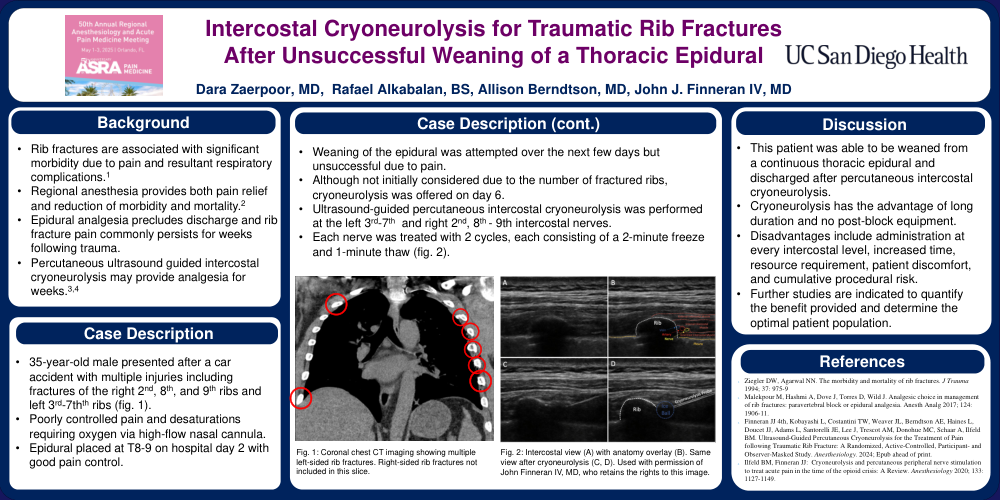
• Ultrasound-guided percutaneous intercostal cryoneurolysis was performed at the left 3rd-7th and right 2nd, 8th - 9th intercostal nerves.
• Each nerve was treated with 2 cycles, each consisting of a 2-minute freeze and 1-minute thaw (fig. 2).
Background
-
Rib fractures are associated with significant morbidity due to pain and resultant respiratory complications.1
-
Regional anesthesia provides both pain relief and reduction of morbidity and mortality.2
-
Epidural analgesia precludes discharge and rib fracture pain commonly persists for weeks following trauma.
-
Percutaneous ultrasound guided intercostal cryoneurolysis may provide analgesia for weeks.3,4
Case Description
-
35-year-old male presented after a car accident with multiple injuries including fractures of the right 2nd, 8th, and 9th ribs and left 3rd-7thth ribs (fig. 1).
-
Poorly controlled pain and desaturations requiring oxygen via high-flow nasal cannula.
-
Epidural placed at T8-9 on hospital day 2 with good pain control.
Discussion
• This patient was able to be weaned from a continuous thoracic epidural and discharged after percutaneous intercostal cryoneurolysis.
• Cryoneurolysis has the advantage of long duration and no post-block equipment.
• Disadvantages include administration at every intercostal level, increased time, resource requirement, patient discomfort, and cumulative procedural risk.
• Further studies are indicated to quantify the benefit provided and determine the optimal patient population.
References Results
1994; 37: 975-9
2. Malekpour M, Hashmi A, Dove J, Torres D, Wild J. Analgesic choice in management
Fig. 1: Coronal chest CT imaging showing multiple left-sided rib fractures. Right-sided rib fractures not included in this slice.
Fig. 2: Intercostal view (A) with anatomy overlay (B). Same view after cryoneurolysis (C, D). Used with permission of John Finneran IV, MD, who retains the rights to this image.
3.
4.
of rib fractures: paravertebral block or epidural analgesia. Anesth Analg 2017; 124: 1906-11.
Finneran JJ 4th, Kobayashi L, Costantini TW, Weaver JL, Berndtson AE, Haines L, Doucet JJ, Adams L, Santorelli JE, Lee J, Trescot AM, Donohue MC, Schaar A, Ilfeld BM. Ultrasound-Guided Percutaneous Cryoneurolysis for the Treatment of Pain following Traumatic Rib Fracture: A Randomized, Active-Controlled, Participant- and Observer-Masked Study. Anesthesiology. 2024; Epub ahead of print.
Ilfeld BM, Finneran JJ: Cryoneurolysis and percutaneous peripheral nerve stimulation to treat acute pain in the time of the opioid crisis: A Review. Anesthesiology 2020; 133: 1127-1149.