383 posters, 2 videos, 1 audios, 8 topics, 28 sessions, 328 authors, 225 institutions
ePostersLive by SciGen Technologies S.A. All rights reserved.
50th Annual Regional Anesthesiology and Acute Pain Medicine Meeting
May 1 - 3, 2025 | Orlando, Florida

6778
SUPINE SCIATIC AND FEMORAL NERVE BLOCKS FOR TRAUMA PATIENT WITH SEVERE BURNS AND ELEVATED ICP: A NOVEL TECHNIQUE.
Poster Presenter
Authors
Affiliations
Part of Topic
Medically Challenging Cases
Supine Sciatic and Femoral Nerve Blocks For Trauma Patient With Severe Burns and Elevated ICP: A Novel Technique
Samuel T Belgique, MD, Elisa L Takelo, MD
INTRODUCTION
Trauma patients with severe burns and traumatic brain injuries (TBIs) present unique challenges in managing pain and preventing secondary neurological insults1. This report highlights the innovative use of supine peripheral nerve blocks to address pain management and intracranial pressure (ICP) control in a critical trauma patient with extensive burns and polytrauma.
MATERIALS & METHODS
As the case report is devoid of patient identifiable information, it is exempt from IRB review requirements as per UNC-Chapel Hill policy. Patient informed consent was obtained for submission of this case report.
CASE SUMMARY
27-year-old male
Injury:
Problem: Pain associated elevated ICP during dressing changes and patient movement.
Goal: Provide analgesia while avoiding exacerbation of elevated ICP.
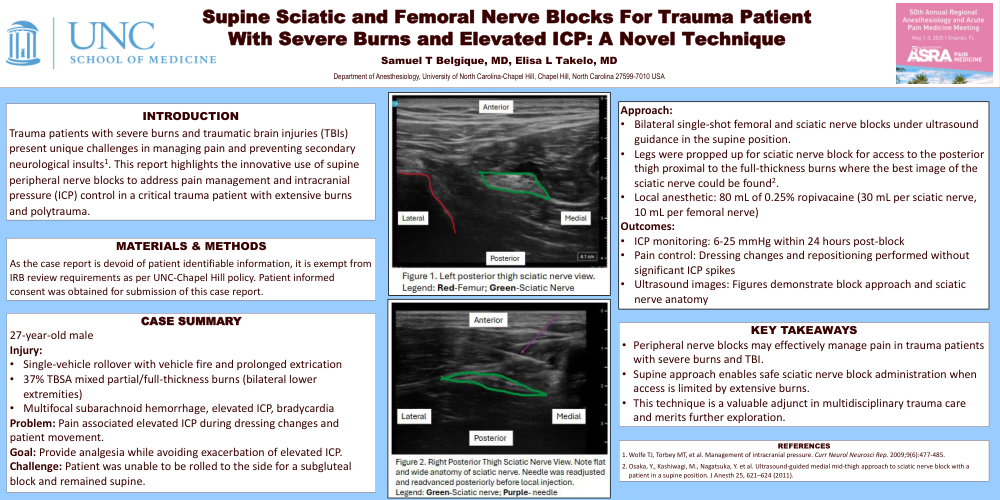
Challenge: Patient was unable to be rolled to the side for a subgluteal block and remained supine.
Approach:
Outcomes:
KEY TAKEAWAYS