383 posters, 2 videos, 1 audios, 8 topics, 28 sessions, 328 authors, 225 institutions
ePostersLive by SciGen Technologies S.A. All rights reserved.
50th Annual Regional Anesthesiology and Acute Pain Medicine Meeting
May 1 - 3, 2025 | Orlando, Florida

6696
INTER-TRANSVERSE PROCESS BLOCK FOLLOWING MULTIPLE RIB FRACTURES IN A PATIENT ON DUAL ANTIPLATELETS: A CASE REPORT
Poster Presenter
Authors
Affiliations
Part of Topic
Medically Challenging Cases
Inter-Transverse Process block for pain control following multiple rib fractures in a patient on dual antiplatelets: A case report
Introduction
Epidural and paravertebral anesthesia have traditionally been considered the gold standard for thoracic pain control. In patients on therapeutic anticoagulation or specific antiplatelet therapy, more superficial thoracic wall blocks are preferred due to lower associated risks of complications. The Inter-Transverse Process (ITP) block is relatively a newer block that can potentially provide chest wall analgesia [1-2].
Case report
A 46-year-old female with a history of Raynaud’s disease, Bell’s palsy, and stroke, on aspirin and clopidogrel presented following a motor vehicle crash. She sustained multiple rib fractures (right ribs 1-7 and left ribs 2-7), and fractures of the sternum, right clavicle, left malleolus, left pubic tubercle, and sacrum. Upon initial evaluation, the patient reported diffuse body pain, primarily over the fractured areas, and difficulty breathing. Initial inspiratory capacity measured with the incentive spirometer was below 500 milliliters; initial oxygen saturation was between 92 to 94% on 4 liters of oxygen. The placement of a thoracic epidural was deferred due to contraindication in the setting of dual anti-platelet therapy. A multimodal pain regimen was initiated, and bilateral ITP catheters were placed. Following the ITP block, notable improvements were observed in the inspiratory volumes, and better pain control was described by the patient, with pain scores decreasing from 10 to 5. No changes were observed in the total 24 hours opioid consumption. It is worth noting that the patient underwent manipulation of the pelvic ring fracture and treatment of the malleolar fracture during hospitalization.
Discussion
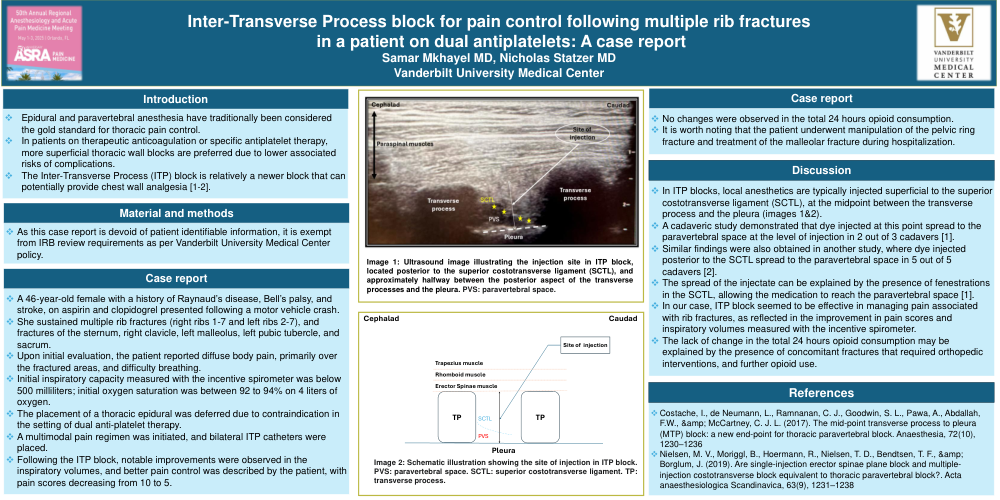
In ITP blocks, local anesthetics are typically injected superficial to the superior costotransverse ligament (SCTL), at the midpoint between the transverse process and the pleura (images 1&2). A cadaveric study demonstrated that dye injected at this point spread to the paravertebral space at the level of injection in 2 out of 3 cadavers[1]. Similar findings were also obtained in another study, where dye injected posterior to the SCTL spread to the paravertebral space in 5 out of 5 cadavers[2]. The spread of the injectate can be explained by the presence of fenestrations in the SCTL, allowing the medication to reach the paravertebral space [1]. In our case, ITP block seemed to be effective in managing pain associated with rib fractures, as reflected in the improvement in pain scores and inspiratory volumes measured with the incentive spirometer. The lack of change in the total 24 hours opioid consumption may be explained by the presence of concomitant fractures that required orthopedic interventions, and further opioid use.