383 posters, 2 videos, 1 audios, 8 topics, 28 sessions, 328 authors, 225 institutions
ePostersLive by SciGen Technologies S.A. All rights reserved.
50th Annual Regional Anesthesiology and Acute Pain Medicine Meeting
May 1 - 3, 2025 | Orlando, Florida

6693
TRUNCAL REGIONAL ANESTHESIA FOR A PATIENT WITH PRUNE BELLY SYNDROME UNDERGOING KIDNEY TRANSPLANT
Poster Presenter
Authors
Affiliations
Part of Topic
Medically Challenging Cases
Truncal Regional Anesthesia for a Patient with Prune Belly Syndrome Undergoing Kidney Transplant
Introduction
•Prune belly syndrome (PBS) is a rare congenital disorder primarily affecting males characterized by underdeveloped abdominal wall musculature, urinary tract abnormalities and cryptorchidism. (1)
• Postoperative analgesia is essential for patients with PBS. Deficient abdominal wall musculature may exacerbate respiratory insufficiency due to splinting. (2,3)
•Altered anatomy of truncal musculature in PBS may prove challenging when performing common regional anesthesia procedures.
•We report the successful use of abdominal fascial plane blocks for postoperative analgesia after kidney transplant in a patient with PBS.
Case Report
•44-year-old male with a history of PBS, obstructive uropathy with associated ESRD and several prior abdominal and urologic surgeries presented for a living-donor renal transplant.
•UTH institutional kidney transplant protocol includes quadratus lumborum (QL) blocks; however, the surgeon noted significant anatomical abnormalities including thin fascia, malrotation of the GI tract, and aberrant arterial supply to the pelvis. Presence of normal regional landmarks on ultrasound was uncertain.
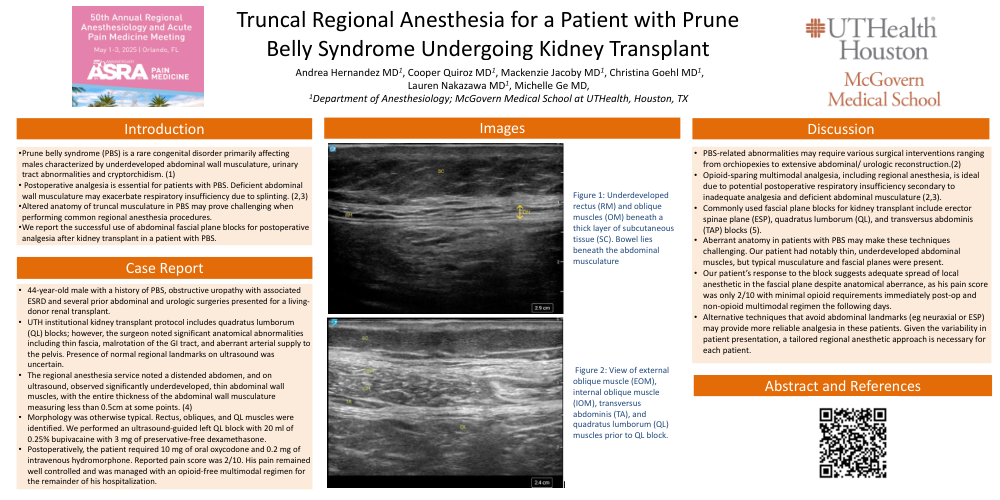
•The regional anesthesia service noted a distended abdomen, and on ultrasound, observed significantly underdeveloped, thin abdominal wall muscles, with the entire thickness of the abdominal wall musculature measuring less than 0.5cm at some points. (4)
•Morphology was otherwise typical. Rectus, obliques, and QL muscles were identified. We performed an ultrasound-guided left QL block with 20 ml of 0.25% bupivacaine with 3 mg of preservative-free dexamethasone.
•Postoperatively, the patient required 10 mg of oral oxycodone and 0.2 mg of intravenous hydromorphone. Reported pain score was 2/10. His pain remained well controlled and was managed with an opioid-free multimodal regimen for the remainder of his hospitalization.
Discussion
•PBS-related abnormalities may require various surgical interventions ranging from orchiopexies to extensive abdominal/ urologic reconstruction.(2)
•Opioid-sparing multimodal analgesia, including regional anesthesia, is ideal due to potential postoperative respiratory insufficiency secondary to inadequate analgesia and deficient abdominal musculature (2,3).
•Commonly used fascial plane blocks for kidney transplant include erector spinae plane (ESP), quadratus lumborum (QL), and transversus abdominis (TAP) blocks (5).
•Aberrant anatomy in patients with PBS may make these techniques challenging. Our patient had notably thin, underdeveloped abdominal muscles, but typical musculature and fascial planes were present.
•Our patient’s response to the block suggests adequate spread of local anesthetic in the fascial plane despite anatomical aberrance, as his pain score was only 2/10 with minimal opioid requirements immediately post-op and non-opioid multimodal regimen the following days.
•Alternative techniques that avoid abdominal landmarks (eg neuraxial or ESP) may provide more reliable analgesia in these patients. Given the variability in patient presentation, a tailored regional anesthetic approach is necessary for each patient.