383 posters, 2 videos, 1 audios, 8 topics, 28 sessions, 328 authors, 225 institutions
ePostersLive by SciGen Technologies S.A. All rights reserved.
50th Annual Regional Anesthesiology and Acute Pain Medicine Meeting
May 1 - 3, 2025 | Orlando, Florida

6647
IN-PLANE AND OUT-OF-PLANE ARTERIAL LINE PLACEMENT IN A QUADRUPLE AMPUTEE WITH RAYNAUD’S SYNDROME AND VASOPASM
Poster Presenter
Authors
Affiliations
Part of Topic
Medically Challenging Cases
In-Plane and Out-of-Plane Arterial Line Placement in a Quadruple Amputee with Raynaud’s Syndrome and Vasospasm
Julie Hall, MD; Cooper Quiroz, MD; Mackenzie Jacoby, MD; Christina Goehl, MD; J. Blair de Haan, MD
Department of Anesthesiology; McGovern Medical School at UTHealth, Houston, TX
Introduction
•Ultrasound-guided arterial line placement is associated with increased first-attempt success rate of cannulation
•The two most common approaches are the long-axis, in-plane approach and the short-axis, out-of-plane approach
•In-plane approach allows for the needle and catheter to be visualized entering the vessel longitudinally, minimizing the risk of inserting the needle into the back wall but limiting the ability to assess if the needle is entering the center of the vessel
•Out-of-plane approach allows for clear centering of the needle in the vessel, but requires a dynamic manipulation to follow the needle tip in real time and has increased operator variation
•Comparative studies suggest in-plane approach is typically associated with lower incidence of posterior wall puncture and higher rates of fist-attempt success
•Most studies exclude individuals with Raynaud’s syndrome or with vasospasm from their study population, leaving the question as to the best approach for line placement in these cohorts unanswered
Case Study
•51-year-old female with history of rheumatoid arthritis, Raynaud’s syndrome, septic shock resulting in bilateral below-knee and bilateral forearm amputations presented for deep inferior epigastric perforator free flaps to bilateral lower extremities for persistent non-healing wounds.
•Given absence of typically favored arterial line targets and desire to avoid a femoral line in the surgical field, an axillary arterial line was pursued.
•Multiple attempts to cannulate the left axillary artery with both in-plane and out-of-plane approaches failed to result in bleed-back through the catheter. Initial out-of-plane approach on the right side also proved unsuccessful.
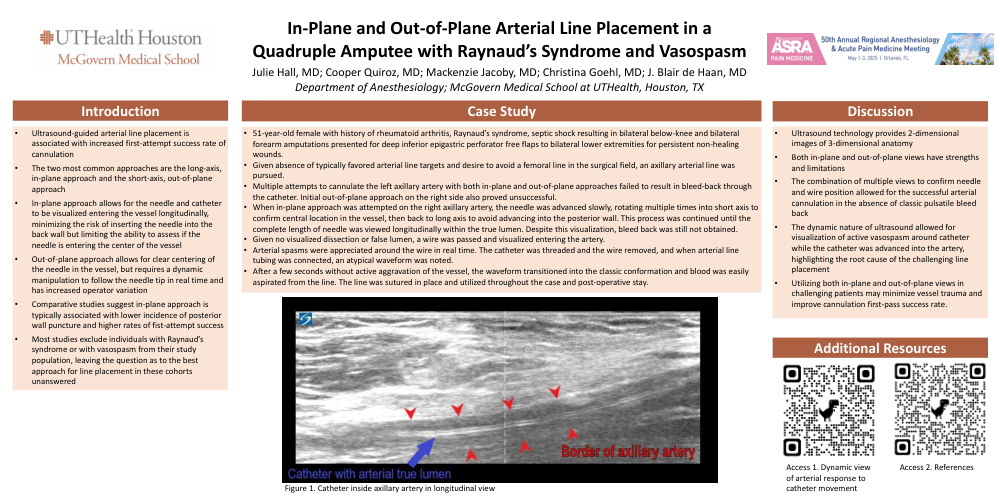
•When in-plane approach was attempted on the right axillary artery, the needle was advanced slowly, rotating multiple times into short axis to confirm central location in the vessel, then back to long axis to avoid advancing into the posterior wall. This process was continued until the complete length of needle was viewed longitudinally within the true lumen. Despite this visualization, bleed back was still not obtained.
•Given no visualized dissection or false lumen, a wire was passed and visualized entering the artery.
•Arterial spasms were appreciated around the wire in real time. The catheter was threaded and the wire removed, and when arterial line tubing was connected, an atypical waveform was noted.
•After a few seconds without active aggravation of the vessel, the waveform transitioned into the classic conformation and blood was easily aspirated from the line. The line was sutured in place and utilized throughout the case and post-operative stay.
Discussion
•Ultrasound technology provides 2-dimensional images of 3-dimensional anatomy
•Both in-plane and out-of-plane views have strengths and limitations
•The combination of multiple views to confirm needle and wire position allowed for the successful arterial cannulation in the absence of classic pulsatile bleed back
•The dynamic nature of ultrasound allowed for visualization of active vasospasm around catheter while the catheter was advanced into the artery, highlighting the root cause of the challenging line placement
•Utilizing both in-plane and out-of-plane views in challenging patients may minimize vessel trauma and improve cannulation first-pass success rate.