Loading...

383 posters, 2 videos, 1 audios, 8 topics, 28 sessions, 328 authors, 225 institutions

ePostersLive by SciGen Technologies S.A. All rights reserved.

6590

RAPID CONVERSION OF HIGH DOSE OXYCODONE TO BUPRENORPHINE WITH KETAMINE AND LIDOCAINE INFUSIONS IN CMPLEX REGIONAL PAIN SYNDROME
Part of Topic

Medically Challenging Cases

Introduction

•Despite having an adverse side effect profile, physicians continue to encounter patients on high dose opioid regimens
•The inpatient setting allows for a monitored, controlled transition from high-risk opioid regimen to safer alternatives upon discharge

Case Description

•44-year-old female with a complex medical history including CRPS admitted for worsening extremity pain
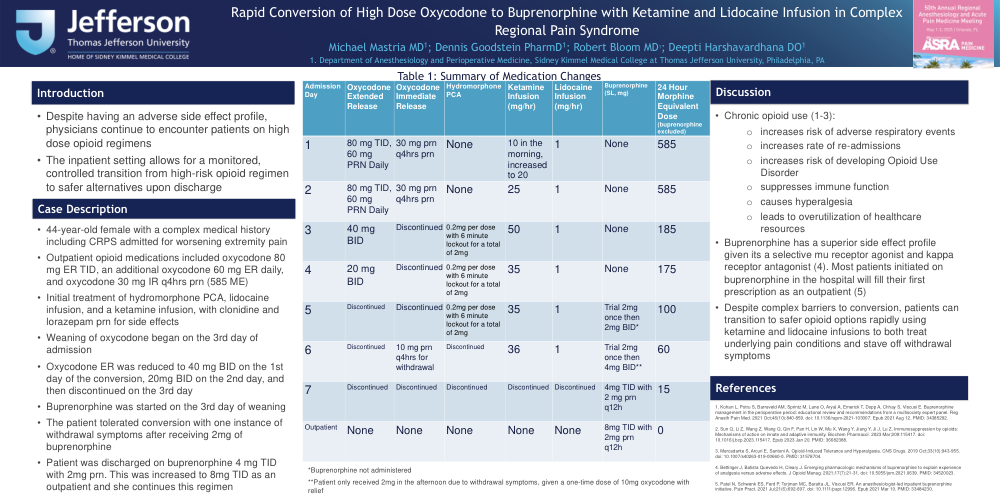
•Outpatient opioid medications included oxycodone 80 mg ER TID, an additional oxycodone 60 mg ER daily, and oxycodone 30 mg IR q4hrs prn (585 ME)
•Initial treatment of hydromorphone PCA, lidocaine infusion, and a ketamine infusion, with clonidine and lorazepam prn for side effects
•Weaning of oxycodone began on the 3rd day of admission
•Oxycodone ER was reduced to 40 mg BID on the 1st day of the conversion, 20mg BID on the 2nd day, and then discontinued on the 3rd day
•Buprenorphine was started on the 3rd day of weaning
•The patient tolerated conversion with one instance of withdrawal symptoms after receiving 2mg of buprenorphine
•Patient was discharged on buprenorphine 4 mg TID with 2mg prn. This was increased to 8mg TID as an outpatient and she continues this regimen

Discussion

•Chronic opioid use (1-3):
oincreases risk of adverse respiratory events
oincreases rate of re-admissions
oincreases risk of developing Opioid Use Disorder
osuppresses immune function
ocauses hyperalgesia
oleads to overutilization of healthcare resources
•Buprenorphine has a superior side effect profile given its a selective mu receptor agonist and kappa receptor antagonist (4). Most patients initiated on buprenorphine in the hospital will fill their first prescription as an outpatient (5)
•Despite complex barriers to conversion, patients can transition to safer opioid options rapidly using ketamine and lidocaine infusions to both treat underlying pain conditions and stave off withdrawal symptoms

References 

1. Kohan L, Potru S, Barreveld AM, Sprintz M, Lane O, Aryal A, Emerick T, Dopp A, Chhay S, Viscusi E. Buprenorphine management in the perioperative period: educational review and recommendations from a multisociety expert panel. Reg Anesth Pain Med. 2021 Oct;46(10):840-859. doi: 10.1136/rapm-2021-103007. Epub 2021 Aug 12. PMID: 34385292.

2. Sun Q, Li Z, Wang Z, Wang Q, Qin F, Pan H, Lin W, Mu X, Wang Y, Jiang Y, Ji J, Lu Z. Immunosuppression by opioids: Mechanisms of action on innate and adaptive immunity. Biochem Pharmacol. 2023 Mar;209:115417. doi: 10.1016/j.bcp.2023.115417. Epub 2023 Jan 20. PMID: 36682388.

3. Mercadante S, Arcuri E, Santoni A. Opioid-Induced Tolerance and Hyperalgesia. CNS Drugs. 2019 Oct;33(10):943-955. doi: 10.1007/s40263-019-00660-0. PMID: 31578704.

4. Bettinger J, Batista Quevedo H, Cleary J. Emerging pharmacologic mechanisms of buprenorphine to explain experience of analgesia versus adverse effects. J Opioid Manag. 2021;17(7):21-31. doi: 10.5055/jom.2021.0639. PMID: 34520023.

5. Patel N, Schwenk ES, Ferd P, Torjman MC, Baratta JL, Viscusi ER. An anesthesiologist-led inpatient buprenorphine initiative. Pain Pract. 2021 Jul;21(6):692-697. doi: 10.1111/papr.12996. Epub 2021 Mar 10. PMID: 33484230.


asraspring2025 banner
Copyright © 2015-2026, ePostersLive® SciGen is a registered trademark of SciGen Technologies S.A. Patent pending.

This website and third-party tools we use rely on cookies for the best user experience. By selecting "I agree", you agree to cookie usage as described in our Privacy Policy.
