383 posters, 2 videos, 1 audios, 8 topics, 28 sessions, 328 authors, 225 institutions
ePostersLive by SciGen Technologies S.A. All rights reserved.
50th Annual Regional Anesthesiology and Acute Pain Medicine Meeting
May 1 - 3, 2025 | Orlando, Florida

6587
ENZYMATIC BURN CARE AND REGIONAL ANESTHESIA GO HAND IN HAND: CASES ON VARIOUS REGIONAL ANESTHETIC TECHNIQUES FOR BURN TREATMENT
Poster Presenter
Authors
Affiliations
Part of Topic
Medically Challenging Cases
Enzymatic Burn Care and Peripheral Nerve Catheters Go Hand in Hand: Cases of Regional Anesthesia for Novel Burn Care Pain
Alexandra Nerantzinis, MD; Shaun Charkowick, MD; Jasper Murphy, BA; Vincent Bargnes III, MD; Sun Mei Liu, MD, MSBA; Eman Nada, MD, PhD
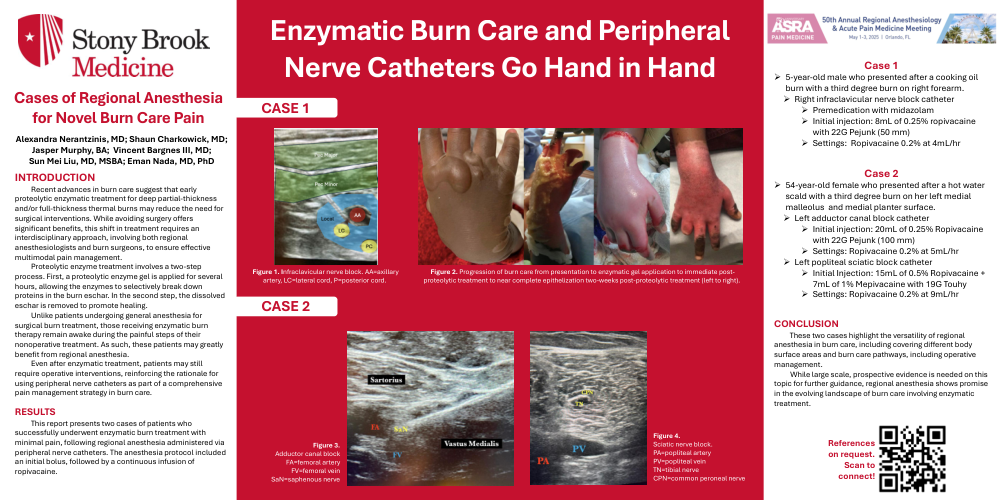
INTRODUCTION Recent advances in burn care suggest that early proteolytic enzymatic treatment for deep partial-thickness and/or full-thickness thermal burns may reduce the need for surgical interventions. While avoiding surgery offers significant benefits, this shift in treatment requires an interdisciplinary approach, involving both regional anesthesiologists and burn surgeons, to ensure effective multimodal pain management. Proteolytic enzyme treatment involves a two-step process. First, a proteolytic enzyme gel is applied for several hours, allowing the enzymes to selectively break down proteins in the burn eschar. In the second step, the dissolved eschar is removed to promote healing. Unlike patients undergoing general anesthesia for surgical burn treatment, those receiving enzymatic burn therapy remain awake during the painful steps of their nonoperative treatment. As such, these patients may greatly benefit from regional anesthesia. Even after enzymatic treatment, patients may still require operative interventions, reinforcing the rationale for using peripheral nerve catheters as part of a comprehensive pain management strategy in burn care.
RESULTS This report presents two cases of patients who successfully underwent enzymatic burn treatment with minimal pain, following regional anesthesia administered via peripheral nerve catheters. The anesthesia protocol included an initial bolus, followed by a continuous infusion of ropivacaine.
Case 1
➢ 5-year-old male who presented after a cooking oil burn with a third degree burn on right forearm.
➢ Right infraclavicular nerve block catheter ➢ Premedication with midazolam
➢ Initial injection: 8mL of 0.25% ropivacaine with 22G Pejunk (50 mm)
➢ Settings: Ropivacaine 0.2% at 4mL/hr
Case 2
➢ 54-year-old female who presented after a hot water scald with a third degree burn on her left medial malleolus and medial planter surface.
➢ Left adductor canal block catheter
➢ Initial injection: 20mL of 0.25% Ropivacaine with 22G Pejunk (100 mm)
➢ Settings: Ropivacaine 0.2% at 5mL/hr ➢ Left popliteal sciatic block catheter
➢ Initial Injection: 15mL of 0.5% Ropivacaine + 7mL of 1% Mepivacaine with 19G Touhy
➢ Settings: Ropivacaine 0.2% at 9mL/hr
CONCLUSION These two cases highlight the versatility of regional anesthesia in burn care, including covering different body surface areas and burn care pathways, including operative management. While large scale, prospective evidence is needed on this topic for further guidance, regional anesthesia shows promise in the evolving landscape of burn care involving enzymatic treatment