Loading...

383 posters, 2 videos, 1 audios, 8 topics, 28 sessions, 328 authors, 225 institutions

ePostersLive by SciGen Technologies S.A. All rights reserved.

6553

EXTERNAL OBLIQUE INTERCOSTAL BLOCK AS AN ALTERNATIVE TO THORACIC EPIDURAL FOR ANALGESIA IN A PATIENT WITH MULTIPLE RIB FRACTURES
Poster Presenter

Sebastian Wozniak

Part of Topic

Medically Challenging Cases

External Oblique Intercostal Block as an Alternative to

Thoracic Epidural for Analgesia in a Patient with Multiple Rib Fractures

Sebastian Wozniak, BS1, Sophia Jacob, MD2, Jacklyn Cho, BS1, Eman Nada, MD PhD2

1Renaissance School of Medicine, Stony Brook University

2Department of Anesthesiology, Stony Brook University Hospital

BACKGROUND

•Poorly controlled pain in the setting of multiple rib fractures can lead to hypoventilation, atelectasis and pneumonia increasing morbidity and mortality, especially in older populations.
 
•Multimodal analgesia including regional anesthesia reduces pain scores and improves patient recovery
•The external oblique intercostal (EOI) block targets the lateral and anterior cutaneous branches of the intercostal nerves (T6-T10) and has been shown to provide effective analgesia in lower thoracic and upper abdominal surgeries. It also offers a promising modality for reducing pain from rib fractures.
 
CASE PRESENTATION

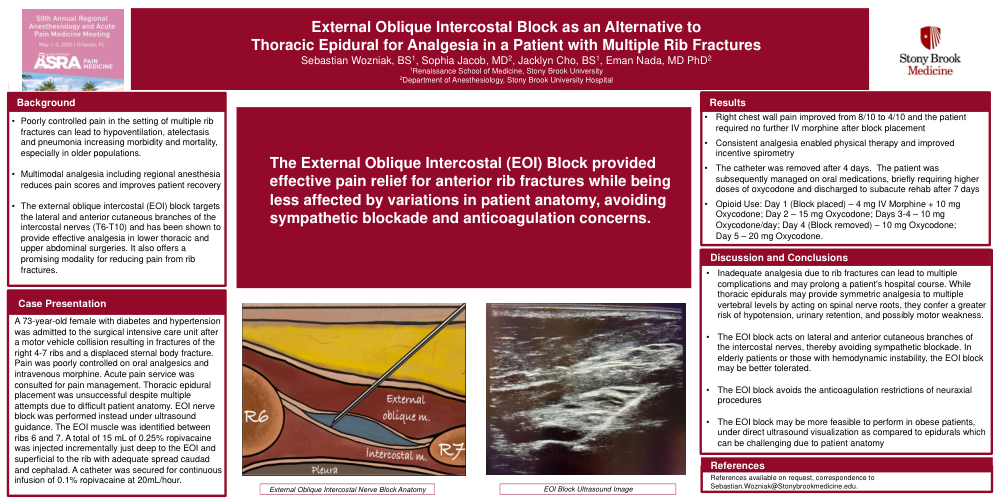
A 73-year-old female with diabetes and hypertension was admitted to the surgical intensive care unit after a motor vehicle collision resulting in fractures of the right 4-7 ribs and a displaced sternal body fracture. Pain was poorly controlled on oral analgesics and intravenous morphine. Acute pain service was consulted for pain management. Thoracic epidural placement was unsuccessful despite multiple attempts due to difficult patient anatomy. EOI nerve block was performed instead under ultrasound guidance. The EOI muscle was identified between ribs 6 and 7. A total of 15 mL of 0.25% ropivacaine was injected incrementally just deep to the EOI and superficial to the rib with adequate spread caudad and cephalad. A catheter was secured for continuous infusion of 0.1% ropivacaine at 20mL/hour.

 RESULTS

•Right chest wall pain improved from 8/10 to 4/10 and the patient required no further IV morphine after block placement
•Consistent analgesia enabled physical therapy and improved incentive spirometry
•The catheter was removed after 4 days.  The patient was subsequently managed on oral medications, briefly requiring higher doses of oxycodone and discharged to subacute rehab after 7 days
•Opioid Use: Day 1 (Block placed) – 4 mg IV Morphine + 10 mg Oxycodone; Day 2 – 15 mg Oxycodone; Days 3-4 – 10 mg Oxycodone/day; Day 4 (Block removed) – 10 mg Oxycodone;        Day 5 – 20 mg Oxycodone.
 
DISCUSSION AND CONCLUSIONS
•Inadequate analgesia due to rib fractures can lead to multiple complications and may prolong a patient's hospital course. While thoracic epidurals may provide symmetric analgesia to multiple vertebral levels by acting on spinal nerve roots, they confer a greater risk of hypotension, urinary retention, and possibly motor weakness.
•The EOI block acts on lateral and anterior cutaneous branches of the intercostal nerves, thereby avoiding sympathetic blockade. In elderly patients or those with hemodynamic instability, the EOI block may be better tolerated. 
•The EOI block avoids the anticoagulation restrictions of neuraxial procedures
•The EOI block may be more feasible to perform in obese patients, under direct ultrasound visualization as compared to epidurals which can be challenging due to patient anatomy

REFERENCES

References available on request, correspondence to Sebastian.Wozniak@Stonybrookmedicine.edu.


asraspring2025 banner
Copyright © 2015-2026, ePostersLive® SciGen is a registered trademark of SciGen Technologies S.A. Patent pending.

This website and third-party tools we use rely on cookies for the best user experience. By selecting "I agree", you agree to cookie usage as described in our Privacy Policy.
