383 posters, 2 videos, 1 audios, 8 topics, 28 sessions, 328 authors, 225 institutions
ePostersLive by SciGen Technologies S.A. All rights reserved.
50th Annual Regional Anesthesiology and Acute Pain Medicine Meeting
May 1 - 3, 2025 | Orlando, Florida

6509
KEEPING THE DIAPHRAGM ALIVE: COSTOCLAVICULAR BLOCK FOR SHOULDER SURGERY IN A SEVERE ASTHMATIC
Poster Presenter
Authors
Part of Topic
Medically Challenging Cases
Keeping The Diaphragm Alive: Costoclavicular Block for Shoulder Surgery in a Severe Asthmatic
Sahitya Hari, D.O., Justine Huang D.O., Christopher Fadumiye M.D.
Department of Anesthesiology, Medical College of Wisconsin
Interscalene brachial plexus blocks (ISB) have generally been considered the gold standard analgesic technique for shoulder surgery for years but recent studies have shown that costoclavicular blocks may provide similar efficacy in pain control while sparing hemidiaphragmatic paralysis1-2. We present a case of a patient with shoulder arthritis and severe asthma undergoing planned total shoulder arthroplasty who received a costoclavicular block (CCB) for perioperative pain control.
60 year old M w/hx of left glenohumeral arthritis with progressively worsening symptoms, including intermittent neuropathy down his arm presents for left reverse total shoulder arthroplasty with planned regional and general anesthesia Other PMH includes severe asthma, moderate sleep apnea, hypertension, gastroesophageal reflux disease and anxiety. Given his severe persistent asthma that was recently increased to triple therapy on theophylline, Dupixent, Breztri, Singulair and rescue albuterol use about every three days, the regional anesthesia team decided to utilize a costoclavicular brachial plexus block to preserve diaphragm function. The procedure passed unremarkably and the patient received adjunct analgesia throughout the surgery with acetaminophen, ketorolac, and hydromorphone. The patient tolerated extubation and transfer to the recovery area without need for supplemental oxygen. The patient continued to have pain relief for an estimated sixteen hours after the procedure with an average pain score of 4/10, after which the nerve block wore off and he regained full sensory and motor function of his right upper extremity.
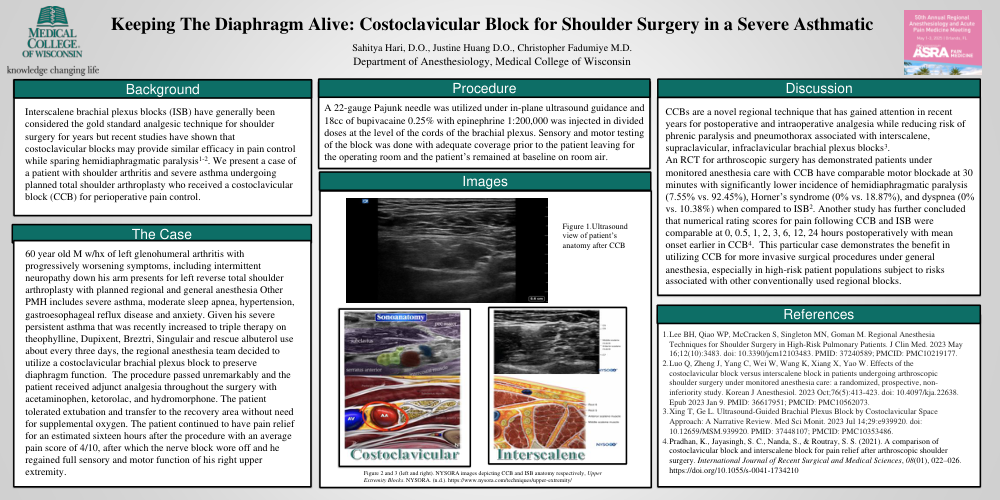
A 22-gauge Pajunk needle was utilized under in-plane ultrasound guidance and 18cc of bupivacaine 0.25% with epinephrine 1:200,000 was injected in divided doses at the level of the cords of the brachial plexus. Sensory and motor testing of the block was done with adequate coverage prior to the patient leaving for the operating room and the patient’s remained at baseline on room air.
CCBs are a novel regional technique that has gained attention in recent years for postoperative and intraoperative analgesia while reducing risk of phrenic paralysis and pneumothorax associated with interscalene, supraclavicular, infraclavicular brachial plexus blocks3.
An RCT for arthroscopic surgery has demonstrated patients under monitored anesthesia care with CCB have comparable motor blockade at 30 minutes with significantly lower incidence of hemidiaphragmatic paralysis (7.55% vs. 92.45%), Horner’s syndrome (0% vs. 18.87%), and dyspnea (0% vs. 10.38%) when compared to ISB2. Another study has further concluded that numerical rating scores for pain following CCB and ISB were comparable at 0, 0.5, 1, 2, 3, 6, 12, 24 hours postoperatively with mean onset earlier in CCB4. This particular case demonstrates the benefit in utilizing CCB for more invasive surgical procedures under general anesthesia, especially in high-risk patient populations subject to risks associated with other conventionally used regional blocks.