383 posters, 2 videos, 1 audios, 8 topics, 28 sessions, 328 authors, 225 institutions
ePostersLive by SciGen Technologies S.A. All rights reserved.
50th Annual Regional Anesthesiology and Acute Pain Medicine Meeting
May 1 - 3, 2025 | Orlando, Florida

6869
SPINAL ANESTHESIA FOR TOTAL HIP ARTHROPLASTY IN AN ACHONDROPLASTIC PATIENT: A CASE STUDY
Poster Presenter
Authors
Affiliations
Part of Topic
Medically Challenging Cases
Spinal Anesthesia for Total Hip Arthroplasty in an Achondroplastic Patient
Introduction
-
Achondroplasia is a disorder that results in skeletal dysplasia, including atlantoaxial instability, kyphoscoliosis, spinal stenosis
-
General anesthesia poses the risk of a potential difficult airway, whereas neuraxial presents challenges of procedure difficulty, unpredictable spread, and higher incidence of neurologic injury
-
Anesthetic plans for this population have reported general anesthesia as the historical preference over neuraxial, particularly for cesarean sections
Case Presentation
-
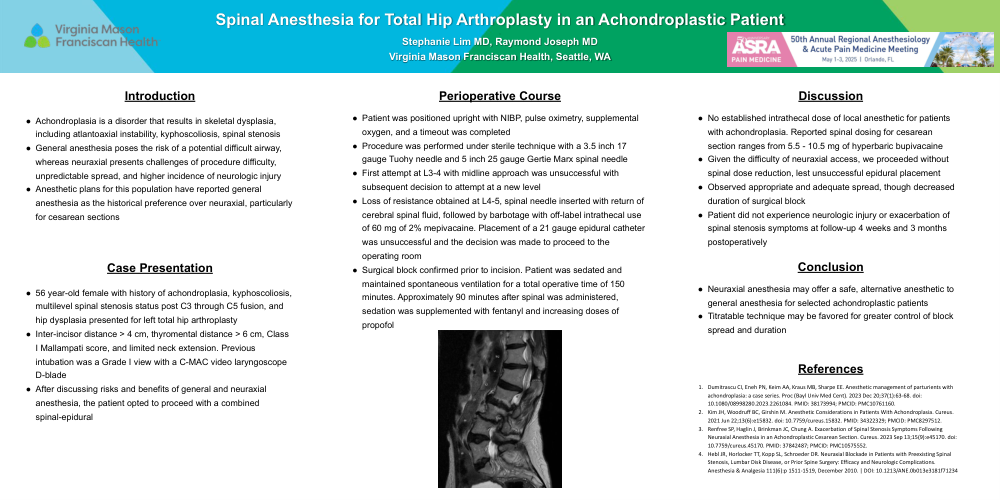
56 year-old female with history of achondroplasia, kyphoscoliosis, multilevel spinal stenosis status post C3 through C5 fusion, and hip dysplasia presented for left total hip arthroplasty
-
Inter-incisor distance > 4 cm, thyromental distance > 6 cm, Class I Mallampati score, and limited neck extension. Previous intubation was a Grade I view with a C-MAC video laryngoscope D-blade
-
After discussing risks and benefits of general and neuraxial anesthesia, the patient opted to proceed with a combined spinal-epidural
Perioperative Course
-
Patient was positioned upright with NIBP, pulse oximetry, supplemental oxygen, and a timeout was completed
-
Procedure was performed under sterile technique with a 3.5 inch 17 gauge Tuohy needle and 5 inch 25 gauge Gertie Marx spinal needle
-
First attempt at L3-4 with midline approach was unsuccessful with subsequent decision to attempt at a new level
-
Loss of resistance obtained at L4-5, spinal needle inserted with return of cerebral spinal fluid, followed by barbotage with off-label intrathecal use of 60 mg of 2% mepivacaine. Placement of a 21 gauge epidural catheter was unsuccessful and the decision was made to proceed to the operating room
-
Surgical block confirmed prior to incision. Patient was sedated and maintained spontaneous ventilation for a total operative time of 150 minutes. Approximately 90 minutes after spinal was administered, sedation was supplemented with fentanyl and increasing doses of propofol
Discussion
-
No established intrathecal dose of local anesthetic for patients with achondroplasia. Reported spinal dosing for cesarean section ranges from 5.5 - 10.5 mg of hyperbaric bupivacaine
-
Given the difficulty of neuraxial access, we proceeded without spinal dose reduction, lest unsuccessful epidural placement
-
Observed appropriate and adequate spread, though decreased duration of surgical block
-
Patient did not experience neurologic injury or exacerbation of spinal stenosis symptoms at follow-up 4 weeks and 3 months postoperatively
Conclusion
-
Neuraxial anesthesia may offer a safe, alternative anesthetic to general anesthesia for selected achondroplastic patients
-
Titratable technique may be favored for greater control of block spread and duration
References
-
Dumitrascu CI, Eneh PN, Keim AA, Kraus MB, Sharpe EE. Anesthetic management of parturients with achondroplasia: a case series. Proc (Bayl Univ Med Cent). 2023 Dec 20;37(1):63-68. doi: 10.1080/08998280.2023.2261084. PMID: 38173994; PMCID: PMC10761160.
-
Kim JH, Woodruff BC, Girshin M. Anesthetic Considerations in Patients With Achondroplasia. Cureus. 2021 Jun 22;13(6):e15832. doi: 10.7759/cureus.15832. PMID: 34322329; PMCID: PMC8297512.
-
Renfree SP, Haglin J, Brinkman JC, Chung A. Exacerbation of Spinal Stenosis Symptoms Following Neuraxial Anesthesia in an Achondroplastic Cesarean Section. Cureus. 2023 Sep 13;15(9):e45170. doi: 10.7759/cureus.45170. PMID: 37842487; PMCID: PMC10575552.
-
Hebl JR, Horlocker TT, Kopp SL, Schroeder DR. Neuraxial Blockade in Patients with Preexisting Spinal Stenosis, Lumbar Disk Disease, or Prior Spine Surgery: Efficacy and Neurologic Complications. Anesthesia & Analgesia 111(6):p 1511-1519, December 2010. | DOI: 10.1213/ANE.0b013e3181f71234