383 posters, 2 videos, 1 audios, 8 topics, 28 sessions, 328 authors, 225 institutions
ePostersLive by SciGen Technologies S.A. All rights reserved.
50th Annual Regional Anesthesiology and Acute Pain Medicine Meeting
May 1 - 3, 2025 | Orlando, Florida

6708
PELVIC PAIN CAUSED BY BERTOLOTTI SYNDROME
Poster Presenter
Authors
Affiliations
Part of Topic
Medically Challenging Cases
Pelvic Pain Caused by Bertolotti Syndrome: A Case Report
-
Bertolotti Syndrome is the pseudoarticulation of the L5 transverse process with the sacrum [4].
-
It is typically associated with low back pain with or without radiating neuropathic pain [2].
-
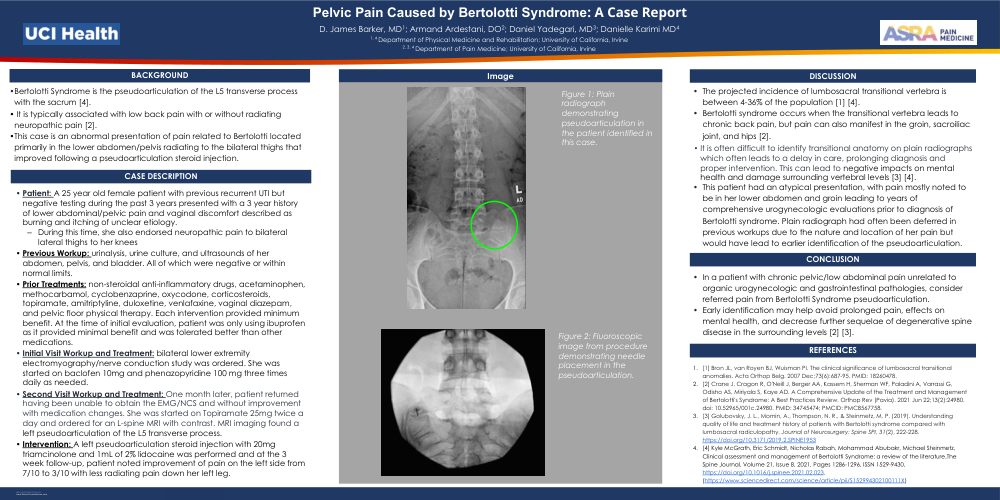
This case is an abnormal presentation of pain related to Bertolotti located primarily in the lower abdomen/pelvis radiating to the bilateral thighs that improved following a pseudoarticulation steroid injection.
-
Patient: A 25 year old female patient with previous recurrent UTI but negative testing during the past 3 years presented with a 3 year history of lower abdominal/pelvic pain and vaginal discomfort described as burning and itching of unclear etiology.
-
During this time, she also endorsed neuropathic pain to bilateral lateral thighs to her knees
-
Previous Workup: urinalysis, urine culture, and ultrasounds of her abdomen, pelvis, and bladder. All of which were negative or within normal limits.
-
Prior Treatments: non-steroidal anti-inflammatory drugs, acetaminophen, methocarbamol, cyclobenzaprine, oxycodone, corticosteroids, topiramate, amitriptyline, duloxetine, venlafaxine, vaginal diazepam, and pelvic floor physical therapy. Each intervention provided minimum benefit. At the time of initial evaluation, patient was only using ibuprofen as it provided minimal benefit and was tolerated better than other medications.
-
Initial Visit Workup and Treatment:bilateral lower extremity electromyography/nerve conduction study was ordered. She was started on baclofen 10mg and phenazopyridine 100 mg three times daily as needed.
-
Second Visit Workup and Treatment: One month later, patient returned having been unable to obtain the EMG/NCS and without improvement with medication changes. She was started on Topiramate 25mg twice a day and ordered for an L-spine MRI with contrast. MRI imaging found a left pseudoarticulation of the L5 transverse process.
-
Intervention: A left pseudoarticulation steroid injection with 20mg triamcinolone and 1mL of 2% lidocaine was performed and at the 3 week follow-up, patient noted improvement of pain on the left side from 7/10 to 3/10 with less radiating pain down her left leg.
-
The projected incidence of lumbosacral transitional vertebra is between 4-36% of the population [1] [4].
-
Bertolotti syndrome occurs when the transitional vertebra leads to chronic back pain, but pain can also manifest in the groin, sacroiliac joint, and hips [2].
-
It is often difficult to identify transitional anatomy on plain radiographs which often leads to a delay in care, prolonging diagnosis and proper intervention. This can lead to negative impacts on mental health and damage surrounding vertebral levels [3] [4].
-
This patient had an atypical presentation, with pain mostly noted to be in her lower abdomen and groin leading to years of comprehensive urogynecologic evaluations prior to diagnosis of Bertolotti syndrome. Plain radiograph had often been deferred in previous workups due to the nature and location of her pain but would have lead to earlier identification of the pseudoarticulation.
-
In a patient with chronic pelvic/low abdominal pain unrelated to organic urogynecologic and gastrointestinal pathologies, consider referred pain from Bertolotti Syndrome pseudoarticulation.
-
Early identification may help avoid prolonged pain, effects on mental health, and decrease further sequelae of degenerative spine disease in the surrounding levels [2] [3].