383 posters, 2 videos, 1 audios, 8 topics, 28 sessions, 328 authors, 225 institutions
ePostersLive by SciGen Technologies S.A. All rights reserved.
50th Annual Regional Anesthesiology and Acute Pain Medicine Meeting
May 1 - 3, 2025 | Orlando, Florida

6652
RARE INCIDENCE OF ADDUCTOR CANAL PERIPHERAL NERVE CATHETER INFECTION
Poster Presenter
Authors
Affiliations
Part of Topic
Medically Challenging Cases
Rare Incidence of Adductor Canal Peripheral Nerve Catheter Infection
Introduction
Adductor canal peripheral nerve catheters (PNC) are commonly used as motor sparing analgesia for knee surgeries with the advantage of improved pain scores, early ambulation and functional recovery.1 Compared to single shot nerve blocks, PNC’s have the advantage of delivering continuous analgesia for extended periods of time. However, PNC’s are inherent niduses for bacterial colonization that can lead to complications ranging from benign inflammation to devastating infections.2 Despite aseptic placement protocols and daily assessment of catheter insertion sites, PNC related infections can still occur. This case report details a rare instance of a PNC infection in a patient who had an adductor canal catheter for seven days.
Case Description
Patient is a 54-year-old male (75.8kg) with no significant past medical history who presented to the hospital after a motor vehicle accident. His injuries included fractures to the left 5-7 ribs, right humerus, left tibia as well as a splenic laceration. At the time of arrival, patient was admitted to the surgical ICU and underwent splenic artery embolization.
On days 9 and 10 of admission, patient underwent left tibial plateau and right humerus open reduction internal fixation, respectively. At the time of his right upper extremity surgery, left adductor canal (AC) and right interscalene (IS) PNC’s were placed for post-operative pain control. Both PNC’s were placed with sterile technique with skin preparation with alcoholic chlorexidine 0.5%, sterile drape, and ultrasound guidance. Then, the catheters were secured with transparent Tegaderm dressing.
The catheters were assessed daily by the in-house regional anesthesia team. On catheter day 4, the catheter dressings were noted to be loose with some leaking of fluid around the left AC PNC insertion site. Subsequently, catheters were reinforced with extra Tegaderms. On catheter day 6, patient noted some mild left anterior thigh pain, but dressings were intact without evidence of erythema, bleeding or leakage of fluid.
On catheter day 7, the right IS PNC was removed without incident however upon removal of left AC PNC, white pustular drainage was noted to be tracking out from the catheter insertion site. On palpation, more drainage was expressed, and patient complained of significant tenderness. One day after catheter removal, catheter insertion site was well healed without erythema, but a small area of induration remained that was mildly tender.
Of note, on catheter day 6, patient had intermittent fevers, a WBC count of 18,000/μL, and thrombocytosis up to almost 1,400,000/µL. After removal of catheters, patient WBC normalized over three days however platelet count remained elevated. The patient was not on any antibiotics at the time.
Discussion
PNC infections are uncommon, even with prolonged use exceeding seven days.3 However, when they occur, they can cause significant morbidity, requiring surgical intervention and extended antibiotic therapy.4 In this case, there seemed to be an underlying infection despite relatively normal topical exam of catheter insertion site.
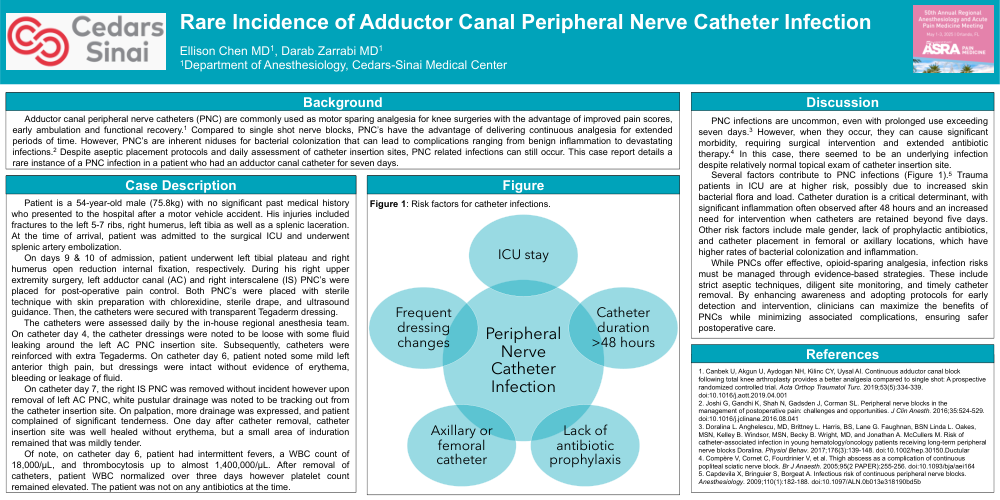
Several factors contribute to PNC infections.5 Trauma patients in ICU are at higher risk, possibly due to increased skin bacterial flora and load. Catheter duration is a critical determinant, with significant inflammation often observed after 48 hours and an increased need for intervention when catheters are retained beyond five days. Other risk factors include male gender, lack of prophylactic antibiotics, and catheter placement in femoral or axillary locations, which have higher rates of bacterial colonization and inflammation.
While PNCs offer effective, opioid-sparing analgesia, infection risks must be managed through evidence-based strategies. These include strict aseptic techniques, diligent site monitoring, and timely catheter removal. By enhancing awareness and adopting protocols for early detection and intervention, clinicians can maximize the benefits of PNCs while minimizing associated complications, ensuring safer postoperative care.