383 posters, 2 videos, 1 audios, 8 topics, 28 sessions, 328 authors, 225 institutions
ePostersLive by SciGen Technologies S.A. All rights reserved.
50th Annual Regional Anesthesiology and Acute Pain Medicine Meeting
May 1 - 3, 2025 | Orlando, Florida

6583
IMPROVEMENT IN POST-OPERATIVE MIGRAINES FOLLOWING TOTAL KNEE REPLACEMENT WITH PERIOPERATIVE ACUPUNCTURE
Poster Presenter
Authors
Affiliations
Part of Topic
Medically Challenging Cases
Improvement in Post-Operative Migraines following Total Knee Replacement with Perioperative Acupuncture
•Chronic migraines affect over one billion people globally and are one of the leading causes of disability worldwide, responsible for significant burdens on the workforce, economy, and healthcare system (1).
•In the US, the average length of hospitalization for migraines is three days, often requiring a multimodal treatment approach of lifestyle modifications, medication, and injections (2).
•Acupuncture has been a mainstay in the treatment of migraines for years, but its effectiveness in the perioperative setting where migraine triggers are abundant has been less explored (3)
•Here we present a case of a patient with a history of chronic migraines who underwent sequential left and right total knee replacements (TKRs), one with acupuncture as part of the intraoperative anesthetic and one without, and the differences in her post-operative course when acupuncture was implemented.
An 82-year-old female with chronic migraines underwent a left TKR.
•Anesthetic plan: spinal (4 mL 3% mepivacaine) with sedation, adductor canal, iPACK, genicular nerve blocks
•Following an uncomplicated operative course, the patient began to experience debilitating migraines and lethargy in the recovery room.
•Migraines were so severe the patient was unable to remember anything for two days or engage with physical therapy. She attributes this migraine exacerbation to anesthesia.
•Delayed discharge until POD #4.
The same patient returned to undergo a right TKR several months later.
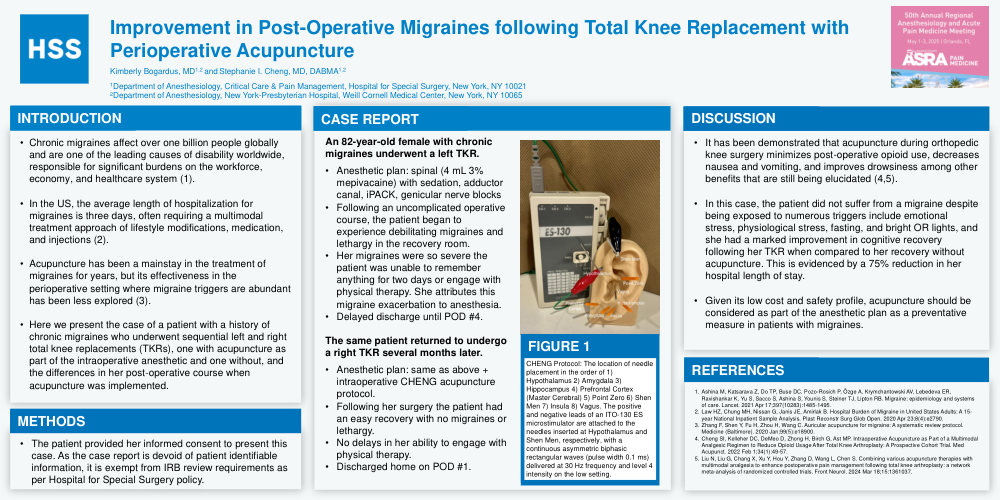
•Anesthetic plan: same as above + intraoperative CHENG acupuncture protocol.
•Following her surgery the patient had an easy recovery with no migraines or lethargy.
•No delays in her ability to engage with physical therapy.
•Discharged home on POD #1.
•It has been demonstrated that acupuncture during orthopedic knee surgery minimizes post-operative opioid use, decreases nausea and vomiting, and improves drowsiness among other benefits that are still being elucidated (4,5).
•
•In this case, the patient did not suffer from a migraine despite being exposed to numerous triggers include emotional stress, physiological stress, fasting, and bright OR lights, and she had a marked improvement in cognitive recovery following her TKR when compared to her recovery without acupuncture. This is evidenced by a 75% reduction in her hospital length of stay.
•
•Given its low cost and safety profile, acupuncture should be considered as part of the anesthetic plan as a preventative measure in patients with migraines.