457 posters, 2 videos, 2 audios, 8 topics, 45 sessions, 401 authors, 265 institutions
ePostersLive by SciGen Technologies S.A. All rights reserved.
49th Annual Regional Anesthesiology and Acute Pain Medicine Meeting
March 21-23, 2024 | The Hilton Bayfront San Diego | San Diego, California

5322
UTILITY OF ERECTOR SPINAE PLANE CATHETERS FOR ROBOTIC CARDIAC SURGERY: A CASE REPORT
Poster Presenter
Authors
Affiliations
Part of Topic
Medically Challenging Cases
Utility of Erector Spinae Plane Catheters for Robotic Cardiac Surgery: A Case Report
Introduction: Advances in regional anesthesia have benefited cardiac surgery patients significantly over the last two decades. Historically, such patients would require high doses of opioids perioperatively, which could render fast track extubation and recovery challenging. For thoracotomy cases, thoracic epidurals could provide excellent analgesia but were also associated with significant risks and side effects, especially with anticoagulation. More recently, fascial plane blocks such as erector spinae plane (ESP), pectoral and serratus anterior plane blocks have been utilized in cardiac surgery, with varying success. Achieving adequate postoperative analgesia in this patient population is of utmost importance to minimize a robust sympathetic response and respiratory recovery, but also chronic pain syndromes, which have been associated with poorly controlled acute pain. Here we present a patient, one of a case series, who underwent robotic mitral valve replacement and received an ESP catheter preoperatively, along with intraoperative cryoablation, which provided excellent analgesia, allowing for rapid recovery and discharge.
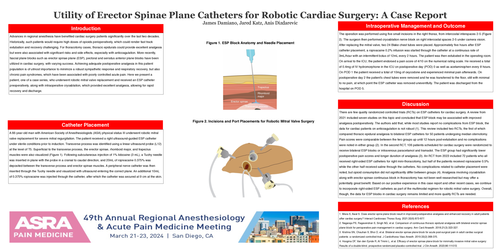
Catheter Placement: A 66-year-old man with American Society of Anesthesiologists (ASA) physical status III underwent robotic mitral valve replacement for severe mitral regurgitation. The patient received a right ultrasound-guided ESP catheter under sterile conditions prior to induction. Transverse process was identified using a linear ultrasound probe (L12) at the level of T5. Superficial to the transverse process, the erector spinae, rhomboid major, and trapezius muscles were also visualized (Figure 1). Following subcutaneous injection of 1% lidocaine (3 mL), a Tuohy needle was inserted in plane with the probe in a cranial to caudal direction, and 20mL of ropivacaine 0.375% was deposited between the transverse process and erector spinae muscles. A peripheral nerve catheter was then inserted through the Tuohy needle and visualized with ultrasound entering the correct plane. An additional 10mL of 0.375% ropivacaine was injected through the catheter, after which the catheter was secured at 9 cm at the skin.
Intraoperative Management and Outcome: The operation was performed using five small incisions in the right thorax, from intercostal interspaces 2-5 (Figure 2). The surgeon then performed cryoablation nerve block on right intercostal spaces 2-5 under camera vision. After replacing the mitral valve, two 24 Blake chest tubes were placed. Approximately five hours after ESP catheter placement, a ropivacaine 0.2% infusion was started through the catheter at a continuous rate of 3mL/hour with an intermittent bolus of 12mL every 2 hours. The patient was then extubated in the operating room. On arrival to the ICU, the patient endorsed a pain score of 4/10 on the numerical rating scale. He received a total of 0.4mg of IV hydromorphone in the ICU on postoperative day (POD) 0 as well as acetaminophen every 8 hours. On POD 1 the patient received a total of 10mg of oxycodone and experienced minimal pain afterwards. On postoperative day 2 the patient’s chest tubes were removed and he was transferred to the floor, still with minimal to no pain, at which point the ESP catheter was removed uneventfully. The patient was discharged from the hospital on POD 5.
Discussion: There are few quality randomized controlled trials (RCTs) on ESP catheters for cardiac surgery. A review from 2021 included seven studies on this topic and concluded that ESP block may be associated with improved analgesia postoperatively. The authors add that, while most studies report no complications from ESP block, the data for cardiac patients on anticoagulation is not robust (1). This review included two RCTs, the first of which compared thoracic epidural analgesia to bilateral ESP catheters for 50 patients undergoing median sternotomy. Pain scores were comparable between the two groups up until 12 hours post-extubation and no complications were noted in either group (2). In the second RCT, 106 patients scheduled for cardiac surgery were randomized to receive bilateral ESP blocks or intravenous paracetamol and tramadol. The ESP group had significantly lower postoperative pain scores and longer duration of analgesia (3). An RCT from 2023 included 72 patients who all received right-sided ESP catheters for right mini-thoracotomy, but half of the patients received ropivacaine 0.5% while the other half received saline through the catheters. No complications related to catheter placement were noted, but opioid consumption did not significantly differ between groups (4). Analgesia involving cryoablation along with erector spinae continuous block in thoracotomy has not been well researched but may offer a potentially great benefit. Based on our positive experience in this case report and other recent cases, we continue to incorporate right-sided ESP catheters as part of the multimodal regimen for robotic mitral valve surgery. Overall, though, the data for ESP blocks in cardiac surgery remains limited and more quality RCTs are needed.
References:
1. Misra S, Awal S. Does erector spine plane block result in improved postoperative analgesia and enhanced recovery in adult patients after cardiac surgery? Interact Cardiovasc Thorac Surg. 2021;32(6):873-877.
2. Nagaraja PS, Ragavendran S, Singh NG, et al. Comparison of continuous thoracic epidural analgesia with bilateral erector spinae plane block for perioperative pain management in cardiac surgery. Ann Card Anaesth. 2018;21(3):323-327.
3. Krishna SN, Chauhan S, Bhoi D, et al. Bilateral erector spinae plane block for acute post-surgical pain in adult cardiac surgical patients: a randomized controlled trial. J Cardiothorac Vasc Anesth. 2019;33(2):368-375.
4. Hoogma DF, Van den Eynde R, Al Tmimi L, et al. Efficacy of erector spinae plane block for minimally invasive mitral valve surgery: Results of a double-blind, prospective randomized placebo-controlled trial. J Clin Anesth. 2023;86:111072.