457 posters, 2 videos, 2 audios, 8 topics, 45 sessions, 401 authors, 265 institutions
ePostersLive by SciGen Technologies S.A. All rights reserved.
49th Annual Regional Anesthesiology and Acute Pain Medicine Meeting
March 21-23, 2024 | The Hilton Bayfront San Diego | San Diego, California

5084
NEOSTIGMINE AND ATROPINE FOR MANAGEMENT OF A POST-DURAL PUNCTURE HEADACHE
Poster Presenter
Authors
Affiliations
Part of Topic
Medically Challenging Cases
Neostigmine and Atropine for Management of a Post-Dural Puncture Headache - Justin Tai, MD | Taylor Tribett, MD | Drew Accordino, MD
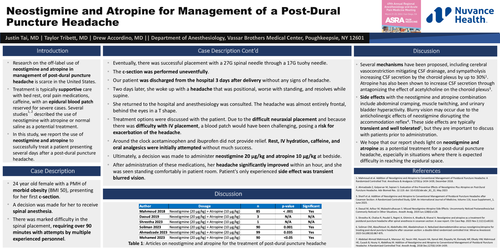
Research on the off-label use of neostigmine and atropine in management of post-dural puncture headache is scarce in the United States. Treatment is typically supportive care with bed rest, oral pain medications, caffeine, with an epidural blood patch reserved for severe cases. Several studies described the use of neostigmine with atropine or normal saline as a potential treatment. In this study, we report the use of neostigmine and atropine to successfully treat a patient presenting several days after a post-dural puncture headache.
24 year old female with a PMH of morbid obesity (BMI 50), presenting for her first c-section. A decision was made for her to receive spinal anesthesia. There was marked difficulty in the spinal placement, requiring over 90 minutes with attempts by multiple experienced personnel. Eventually, there was successful placement with a 27G spinal needle through a 17G tuohy needle. The c-section was performed uneventfully. Our patient was discharged from the hospital 3 days after delivery without any signs of headache. Two days later, she woke up with a headache that was positional, worse with standing, and resolves while supine. She returned to the hospital and anesthesiology was consulted. The headache was almost entirely frontal, behind the eyes in a T shape. Treatment options were discussed with the patient. Due to the difficult neuraxial placement and because there was difficulty with IV placement, a blood patch would have been challenging, posing a risk for exacerbation of the headache. Around the clock acetaminophen and ibuprofen did not provide relief. Rest, IV hydration, caffeine, and oral analgesics were initially attempted without much success. Ultimately, a decision was made to administer neostigmine 20 μg/kg and atropine 10 μg/kg at bedside. After administration of these medications, her headache significantly improved within an hour, and she was seen standing comfortably in patient room. Patient's only experienced side effect was transient blurred vision.
Several mechanisms have been proposed, including cerebral vasoconstriction mitigating CSF drainage, and sympatholysis increasing CSF secretion by the choroid plexus by up to 30%. Atropine has also been shown to increase CSF secretion through antagonizing the effect of acetylcholine on the choroid plexus. Side effects with the neostigmine and atropine combination include abdominal cramping, muscle twitching, and urinary bladder hyperactivity. Blurry vision may occur due to the anticholinergic effects of neostigmine disrupting the accommodation reflex4. These side effects are typically transient and well tolerated, but they are important to discuss with patients prior to administration. We hope that our report sheds light on neostigmine and atropine as a potential treatment for a post-dural puncture headache, especially in situations where there is expected difficulty in reaching the epidural space.