457 posters, 2 videos, 2 audios, 8 topics, 45 sessions, 401 authors, 265 institutions
ePostersLive by SciGen Technologies S.A. All rights reserved.
49th Annual Regional Anesthesiology and Acute Pain Medicine Meeting
March 21-23, 2024 | The Hilton Bayfront San Diego | San Diego, California

5078
PALLIATIVE ERECTOR SPINAE PLANE NEUROLYSIS FOR METASTATIC THORACIC PARASPINAL PAIN
Poster Presenter
Authors
Affiliations
Part of Topic
Medically Challenging Cases
Palliative Erector Spinae Plane Neurolysis for Metastatic Thoracic Paraspinal Pain
•Metastasis from pancreatic cancer to any skeletal muscle is exceedingly rare, especially to the thoracic region with incidence <1%
•Treatment of pain related to these tumors includes surgical removal and a multimodal pain medicine regimen
•We present a case where an ESP neurolysis was used successfully to manage pain from a pancreatic metastatic mass within the thoracic paraspinal muscle
•82-year-old woman with metastatic pancreatic cancer presented to our clinic with intractable mid-thoracic pain despite oral pain medications
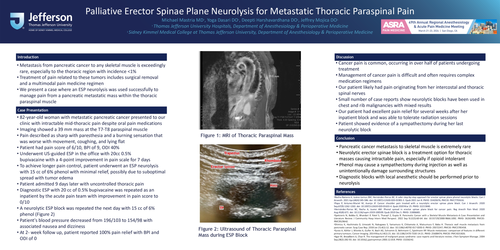
•Imaging showed a 39 mm mass at the T7-T8 paraspinal muscle
•Pain described as sharp with paresthesia and a burning sensation that was worse with movement, coughing, and lying flat
•Patient had pain score of 6/10, BPI of 9, ODI 40%
•Underwent US-guided ESP in the office with 20cc 0.5% bupivacaine with a 4-point improvement in pain scale for 7 days
•To achieve longer pain control, patient underwent an ESP neurolysis with 15 cc of 6% phenol with minimal relief, possibly due to suboptimal spread with tumor edema
•Patient admitted 9 days later with uncontrolled thoracic pain
•Diagnostic ESP with 20 cc of 0.5% bupivacaine was repeated as an inpatient by the acute pain team with improvement in pain score to 0/10
•A neurolytic ESP block was repeated the next day with 15 cc of 6% phenol (Figure 2)
•Patient's blood pressure decreased from 196/103 to 154/98 with associated nausea and dizziness
•At 2- week follow up, patient reported 100% pain relief with BPI and ODI of 0
•Cancer pain is common, occurring in over half of patients undergoing treatment
•Management of cancer pain is difficult and often requires complex medication regimens
•Our patient likely had pain originating from her intercostal and thoracic spinal nerves
•Small number of case reports show neurolytic blocks have been used in chest and rib malignancies with mixed results
•Our patient had excellent pain relief for several weeks after her inpatient block and was able to tolerate radiation sessions
•Patient showed evidence of a sympathectomy during her last neurolytic block
•Pancreatic cancer metastasis to skeletal muscle is extremely rare
•Neurolytic erector spinae block is a treatment option for thoracic masses causing intractable pain, especially if opioid intolerant
•Phenol may cause a sympathectomy during injection as well as unintentionally damage surrounding structures
•Diagnostic blocks with local anesthetic should be performed prior to neurolysis