457 posters, 2 videos, 2 audios, 8 topics, 45 sessions, 401 authors, 265 institutions
ePostersLive by SciGen Technologies S.A. All rights reserved.
49th Annual Regional Anesthesiology and Acute Pain Medicine Meeting
March 21-23, 2024 | The Hilton Bayfront San Diego | San Diego, California

5314
EPIDURAL BLOCKADE FOLLOWING UNILATERAL SINGLE-SHOT PARAVERTEBRAL NERVE BLOCK (MTP APPROACH)
Poster Presenter
Authors
Affiliations
Part of Topic
Medically Challenging Cases
Epidural blockade following unilateral single-shot paravertebral nerve block (MTP approach)
George Gadalla, MD; Jeremy Kearns, MD
University of Pittsburgh Medical Center
Introduction
The thoracic paravertebral nerve block (TPVB) is a regional anesthesia technique meant to provide ipsilateral somatic and sympathetic nervous blockade at a given vertebral level, along with coverage of contiguous superior and inferior dermatomes. Its uses include, but are not limited to, acute pain management in the post-operative and post-traumatic periods, as well as surgical anesthesia in select cases. As this is a technique targeting a space contiguous with the epidural space, there is risk of epidural spread and blockade after TPVB. This case report demonstrates likely epidural spread after unilateral single-shot TPVB.
The thoracic paravertebral space (TPVS) is a wedge-shaped space that exists on either side of the vertebral column. It contains the spinal nerves as they split into ventral rami, dorsal rami, and sympathetic ganglia. It is bordered anterolaterally by the parietal pleura, medially by the vertebral column, and posteriorly by the superior costotransverse ligament (SCTL) and transverse processes. The space is contiguous laterally with the intercostal space, medially with the epidural space, and superiorly/inferiorly with adjacent paravertebral spaces (1).
There are multiple approaches to the TPVB, including parasagittal and intercostal, and the block can be performed with ultrasound (US) guidance or via anatomical landmarks. A variation of the TPVB, termed the mid-point transverse process to pleura (MTP) block, may be performed immediately superficial to the SCTL. The MTP block has been hypothesized to achieve paravertebral spread medially between the SCTL and the vertebral body, laterally via the internal intercostal membrane, and via fenestrations in the SCTL (2). The MTP approach to the PVB has been shown to be noninferior to the “true” PVB (3).
The TPVB is a versatile block which can provide unilateral coverage to specific dermatomal levels with reliable spread to contiguous dermatomes superiorly and inferiorly; with a single injection of 15 cc 0.5% bupivacaine, somatic blockade has been shown to spread an average of 5 dermatomes and sympathetic blockade an average of 8 dermatomes (1). Note that this volume and spread was from a “true” PVB, not a more superficial approach, such as an MTP. Indications for this block include thoracic surgery, breast surgery, chest wall surgery, analgesia in the post-trauma setting, and abdominal surgery. The block may be paired with a contralateral TPVB to provide bilateral coverage and/or with an ipsilateral TPVB to provide extended dermatomal coverage. It may also be performed as a single-shot block or with catheter placement.
Contraindications to the TPVB include infection, paravertebral space tumors at the level of injection, severe coagulopathy, severe respiratory disease necessitating use of intercostal muscles, severe spinal deformities, and patient refusal (4). As with all regional anesthetics, complications include bleeding, infection, and damage to surrounding structures; specifically, this includes inadvertent pleural puncture which may be associated with pneumothorax. Hypotension has also been documented, likely due to sympathectomy leading to relative hypovolemia. Additional complications may arise with spread of local anesthetic medially, resulting in epidural or even intrathecal blockade after dural puncture (1).
Materials and Methods
At the University of Pittsburgh Medical Center, consent for case reports that do not contain any identifiable patient information is embedded into the general anesthesia consent, which all patients signed. At the University of Pittsburgh Medical Center, the Acute Interventional Perioperative Pain Service also has standing IRB approval for a pain service registry.
Results/Case Report
A 72-year-old male with dyspnea and a newly found left-sided pleural effusion presented for left video-assisted thoracoscopic surgery (VATS) and pleural biopsy. Preoperatively, a left-sided single-shot PVB (T4 level, MTP approach) was performed under US guidance. A total of 30 cc of 0.375% bupivacaine was injected in incremental doses after negative aspiration. Approximately 40 minutes afterward when the patient was brought to the operating room (OR), he reported bilateral lower extremity weakness/numbness and an inability to move himself from the stretcher to the OR bed. The case proceeded normally after OR staff moved the patient. Postoperatively, the patient was able to move his lower extremities but reported numbness, which gradually resolved over the next few hours. When patient was examined on post-operative day 1, he had full resolution of both motor and sensory symptoms. The Acute Pain team had an extensive discussion with the patient establishing the progression and subsequent regression of his symptoms. The team discussed the possibility of epidural spread of local anesthetic being a cause of these symptoms. The patient demonstrated understanding and had no further questions.
Discussion
Varying degrees of epidural spread of local anesthetic have been demonstrated after 70% of percutaneous paravertebral injections (1), the vast majority of which are unilateral and involve a volume too small to produce clinically significant symptoms. Clinically significant contralateral symptoms are much less likely, occurring after 1.1% of paravertebral injections. Bilateral symptoms may be caused by significant epidural spread, by intrathecal injection, or by spread to the contralateral TPVS. Additionally, medial injection techniques or the use of large volumes of local anesthetic may increase risk of neuraxial spread.
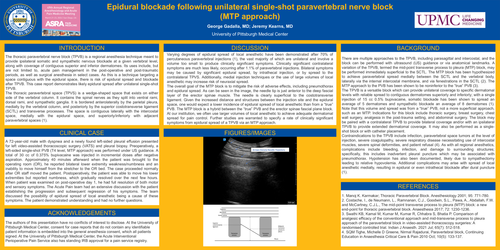
The overall goal of the MTP block is to mitigate the risk of adverse effects, including pneumothorax and epidural spread. As can be seen in the image, the needle tip is just anterior to the deep fascial layer of the erector spinae muscle. The needle is clearly superficial to the costotransverse ligament. Given the increased distance and structures between the injection site and the epidural space, one would expect a lower incidence of epidural spread of local anesthetic than from a “true” PVB. The MTP block is a hybrid between the “true” PVB and the erector spinae fascial plane block. At our institution, we often use larger volumes of local anesthetic to achieve adequate dermatomal spread for pain control. Further studies are warranted to specify a rate of clinically significant symptoms from epidural spread of a TPVB via an MTP approach.
References
1. Manoj K. Karmakar; Thoracic Paravertebral Block. Anesthesiology 2001; 95: 771-780.
2. Costache, I., de Neumann, L., Ramnanan, C.J., Goodwin, S.L., Pawa, A., Abdallah, F.W. and McCartney, C.J.L., The mid-point transverse process to pleura (MTP) block: a new end-point for thoracic paravertebral block. Anaesthesia 2017; 72: 1230-1236.
3. Swathi KB, Kamal M, Kumar M, Kumar R, Chhabra S, Bhatia P. Comparison of analgesic efficacy of the conventional approach and mid-transverse process to pleura approach of the paravertebral block in video-assisted thoracoscopy surgeries: A randomised controlled trial. Indian J Anaesth. 2021 Jul; 65(7): 512-518.
4. SQM Tighe, Michelle D Greene, Nirmal Rajadurai, Paravertebral block, Continuing Education in Anaesthesia Critical Care & Pain 2010 Oct; 10(5): 133-137.