457 posters, 2 videos, 2 audios, 8 topics, 45 sessions, 401 authors, 265 institutions
ePostersLive by SciGen Technologies S.A. All rights reserved.
49th Annual Regional Anesthesiology and Acute Pain Medicine Meeting
March 21-23, 2024 | The Hilton Bayfront San Diego | San Diego, California

5149
ANTICOAGULATION MANAGEMENT DURING A SPINAL CORD STIMULATOR TRIAL ON A PATIENT WITH ST ELEVATION MYOCARDIAL INFARCTION
Poster Presenter
Authors
Affiliations
Part of Topic
Medically Challenging Cases
Anticoagulation management during a Spinal Cord Stimulator trial on a patient with ST Elevation Myocardial Infarction
Introduction:
•Failed back surgery syndrome and post-laminectomy syndrome are defined as lumbar spinal pain that persists despite surgical intervention (1).
•Spinal cord stimulation (SCS) is the most used implantable neuromodulation modality for the management of post-laminectomy pain and failed back surgery syndrome.
•Per the ASRA guidelines, SCS is considered a "high risk procedure" as it pertains to bleeding risk. As a result, strict anticoagulation guidelines should be followed to reduce the risk of epidural bleeding and consequent neurological injury (2).
•We present a case of a spinal cord stimulation trial, where the patient was diagnosed with a ST elevation myocardial infarction on day 4 out of 7 of his SCS trial.
•This case illustrates 2 important competing factors in a patient who is undergoing SCS trial while having an ST elevation MI: The need for anticoagulation to avoid in-stent thrombosis versus the need to stop anticoagulation to safely remove the epidural SCS leads without causing epidural hematoma and neurological injury.
Case Presentation:
•The patient is a 70-year-old male with who had previously undergone 3 lumbar surgeries, L1-L5 decompression laminectomies and T11-S1 fusion, because of lumbar spondylosis with radiculopathy and lumbar stenosis with neurogenic claudication.
•Despite previous surgical intervention, the patient continued to have low back pain and left lower extremity pain. After failing conservative medical management, and interventional steroid injections, spinal cord stimulation was considered.
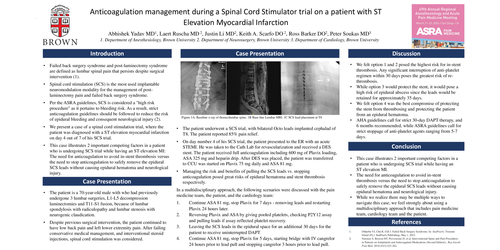
•The patient underwent a SCS trial, with bilateral Octo leads implanted cephalad of T8. The patient reported 85% pain relief.
•On day number 4 of his SCS trial, the patient presented to the ER with an acute STEMI. He was taken to the Cath Lab for revascularization and received a DES stent. The patient received full anticoagulation including 600 mg of Plavix loading, ASA 325 mg and heparin drip. After DES was placed, the patient was transferred to CCU was started on Plavix 75 mg daily and ASA 81 mg.
•Managing the risk and benefits of pulling the SCS leads vs. stopping anticoagulation posed great risks of epidural hematoma and stent thrombosis respectively.
In a multidisciplinary approach, the following scenarios were discussed with the pain medicine team, the patient, and the cardiology team:
1.Continue ASA 81 mg, stop Plavix for 7 days - removing leads and restarting Plavix 24 hours later.
2.Reversing Plavix and ASA by giving pooled platelets, checking P2Y12 assay and pulling leads if assay reflected platelet recovery.
3.Leaving the SCS leads in the epidural space for an additional 30 days for the patient to receive uninterrupted DAPT
4.Continue ASA 81 mg, stop Plavix for 5 days, starting bridge with IV cangrelor 24 hours prior to lead pull and stopping cangrelor 3 hours prior to lead pull.
Discussion:
•We felt option 1 and 2 posed the highest risk for in-stent thrombosis. Any significant interruption of anti-platelet regimen within 30 days poses the greatest risk of re-thrombosis.
•While option 3 would protect the stent, it would pose a high risk of epidural abscess since the leads would be retained for approximately 35 days.
•We felt option 4 was the best compromise of protecting the stent from thrombosing and protecting the patient from an epidural hematoma.
•AHA guidelines call for strict 30-day DAPT therapy, and 6 months recommended, while ASRA guidelines call for strict stoppage of anti-platelet agents ranging from 5-7 days.
Conclusion:
•This case illustrates 2 important competing factors in a patient who is undergoing SCS trial while having an ST elevation MI.
•The need for anticoagulation to avoid in-stent thrombosis versus the need to stop anticoagulation to safely remove the epidural SCS leads without causing epidural hematoma and neurological injury.
•While we realize there may be multiple ways to navigate this case, we feel strongly about using a multidisciplinary approach that includes pain medicine team, cardiology team and the patient.