457 posters, 2 videos, 2 audios, 8 topics, 45 sessions, 401 authors, 265 institutions
ePostersLive by SciGen Technologies S.A. All rights reserved.
49th Annual Regional Anesthesiology and Acute Pain Medicine Meeting
March 21-23, 2024 | The Hilton Bayfront San Diego | San Diego, California

5165
ULTRASOUND-GUIDED PERCUTANEOUS CRYONEUROLYSIS FOR ACUTE PAIN MANAGEMENT AFTER WRIST DISARTICULATION WITH FOREARM DEGLOVING
Poster Presenter
Part of Topic
Medically Challenging Cases
Ultrasound-Guided Percutaneous Cryoneurolysis for Acute Pain Management After Wrist Disarticulation with Forearm Degloving
Gosey B, Jacoby MJ, Said E, Sen S, Wu M, Shoham D, Patterson VM, Hernandez N.
Persistent post-surgical pain (PPSP) contributes to impaired rehabilitation, longer hospital stays, and decreased quality of life. Continuous peripheral nerve blocks (PNBs) are limited by external reservoir volumes, unwanted motor weakness, and risk of infection. Ultrasound-guided percutaneous cryoneurolysis (USGPC) provides prolonged analgesia but has not been described for motor-sparing analgesia of the forearm via antebrachial cutaneous nerves (ACNs).
Case
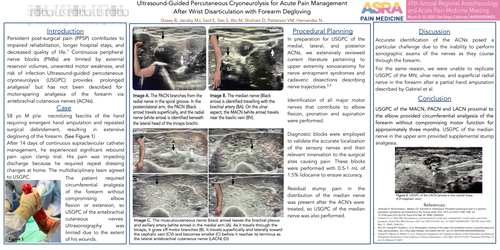
58 yo M p/w necrotizing fasciitis of the hand requiring emergent hand amputation and repeated surgical debridement, resulting in extensive degloving of the forearm. (See Figure 1) After 14 days of continuous supraclavicular catheter management, he experienced significant rebound pain upon clamp trial. His pain was impeding discharge because he required repeat dressing changes at home. The multidisciplinary team agreed to USGPC. The patient required circumferential analgesia of the forearm without compromising elbow flexion or extension, so USGPC of the antebrachial cutaneous nerves. Ultrasonography was limited due to the extent of his wounds.
Procedural Planning
In preparation for USGPC of the medial, lateral, and posterior ACNs, we extensively reviewed current literature pertaining to upper extremity sonoanatomy for nerve entrapment syndromes and cadaveric dissections describing nerve trajectories. Identification of all major motor nerves that contribute to elbow flexion, pronation and supination were performed. Diagnostic blocks were employed to validate the accurate localization of the sensory nerves and their relevant innervation to the surgical sites causing pain. These blocks were performed with 0.5-1 mL of 1.5% lidocaine to ensure accuracy. Residual stump pain in the distribution of the median nerve was present after the ACN’s were treated, so USGPC of the median nerve was also performed.
Discussion
Accurate identification of the ACNs posed a particular challenge due to the inability to perform sonographic exams of the nerves as they course through the forearm. For the same reason, we were unable to replicate USGPC of the MN, ulnar nerve, and superficial radial nerve in the forearm after a partial hand amputation described by Gabriel et al.
Conclusion
USGPC of the MACN, PACN and LACN proximal to the elbow provided circumferential analgesia of the forearm without compromising motor function for approximately three months. USGPC of the median nerve in the upper arm provided supplemental stump analgesia