457 posters, 2 videos, 2 audios, 8 topics, 45 sessions, 401 authors, 265 institutions
ePostersLive by SciGen Technologies S.A. All rights reserved.
49th Annual Regional Anesthesiology and Acute Pain Medicine Meeting
March 21-23, 2024 | The Hilton Bayfront San Diego | San Diego, California

5215
POPLITEAL SCIATIC NERVE BLOCK FOR MANAGEMENT OF REFERRED CANCER PAIN IN THE LOWER EXTREMITY
Part of Topic
Medically Challenging Cases
Popliteal Sciatic Nerve Block for Management of Referred Cancer Pain in the Lower Extremity
Cory Johnson, MD Resident, University of Colorado School of Medicine – Department of Anesthesiology
Keleigh McLaughlin, MD Assistant Professor, University of Colorado – Department of Anesthesiology
Background
Referred pain – Pain that originates distal, and often separate (as seen in shoulder pain with diaphragm irritation) to the affectedlocation without identifying pathologies in the local area.
Two theories - Central sensitization and convergence of nociceptive nerve endings on second order neurons in the spinal cord
Pain signals travel from peripheral to central via A-delta and C fibers.
Cancer-related pain often falls into its own category, but follows similar nociceptive mechanisms.
Mesenchymal chondrosarcoma is an uncommon and aggressive bone/soft tissue malignancy that affects all genders equally with a mean age of 37 years old.
With axial skeleton lesions, the likelihood of nerve involvement is very high and difficult to treat. They can result in radiculopathy, radicular pain, referred pain, and localized cancer pain.
The following describes a case of referred cancer pain that was relieved by peripheral nerve block distal to the area of the lesion.
Conclusions
Further evidence of the dichotomizing afferent fiber reflex theory on referred pain.
Peripheral nerve blockade may create a “sub-threshold” state, thereby reducing the likelihood of pain transmission.
A potential “reset switch” for secondary pathways.
Bench research has suggested a similar theory, but little clinical evidence exists to support the theory.
Implications
Current management of referred pain isaccomplished by treatment oftheprimary pain source, physiotherapy,psychotherapy, aswell as pharmacologic interventions.
Peripheral nerve blockade may add another tool to this difficult to treat pathology. Radicular pain may not benefit from similar procedures due to its chronic inflammatory state and direct nerve-root based mechanisms. However, with distal to proximal effect seen in this case and the second order neuron priming concept, it may be something worth investigating.
Disclosures
I have no personal disclosures regarding any of the information presented.
Methods
Patient informed consent was obtained for this case report. All information was deidentified. Any information that may impact patient care was reported to the primary service provider and patient. Per Colorado Multiple Institutional Review Board policy, IRB review is not required for de-identified, single patient case reports.
Case Report
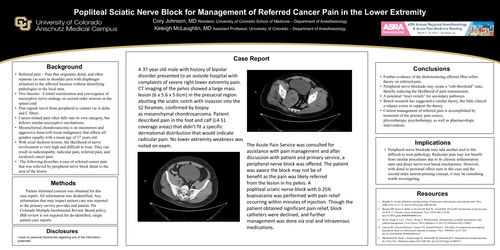
A 37 year old male with history of bipolar disorder presented to an outside hospital with complaints of severe right lower extremity pain. CT imaging of the pelvis showed a large mass lesion (6 x 5.6 x 5.6cm) in the presacral region abutting the sciatic notch with invasion into the S2 foramen, confirmed by biopsy asmesenchymalchondrosarcoma. Patient describedpain in thefootand calf(L4-S1 coverage areas) that didn’t fit a specific dermatomal distribution that would indicate radicular pain.No lower extremity weakness was noted on exam.
TheAcute Pain Service was consulted for assistance with pain management and after discussion with patient and primary service, a peripheral nerve block was offered. The patient was awaretheblock may not be of benefitasthepainwaslikely referred fromthelesionin his pelvis. A poplitealsciaticnerve block with 0.25% bupivacaine was performed with pain relief occurring within minutes of injection. Though the patient obtained significant pain relief, block catheters weredeclined,and further management was done via oral and intravenous medications.
Resources
1. Bogduk N. On the definitions and physiology of back pain, referred pain, and radicular pain. Pain. 2009;147(1-3):17-19. doi:10.1016/j.pain.2009.08.020
2. Bennett MI, Kaasa S, Barke A, Korwisi B, Rief W, Treede RD. The IASP classification of chronic pain for ICD-11: Chronic cancer-related pain. Pain. 2019;160(1):38-44. doi:10.1097/j.pain.0000000000001363
3. Jin Q, Chang Y, Lu C, Chen L, Wang Y. Referred pain: characteristics, possible mechanisms, and clinical management. Front Neurol. 2023;14(June):1-6. doi:10.3389/fneur.2023.1104817
4. Laursen RJ, Graven-Nielsen T, Jensen TS, Arendt-Nielsen L. The effect of compression and regional anaesthetic block on referred pain intensity in humans. Pain. 1999;80(1-2):257-263. doi:10.1016/S0304-3959(98)00214-0
5. Mendenhall W, Reith J, Scarborough M, Stechmiller B, Mendenhall N. Mesenchymal chondrosarcoma. Int J Part Ther. Published online 2016:300-304. doi:10.14338/ijpt-16-00019.1
Resources