457 posters, 2 videos, 2 audios, 8 topics, 45 sessions, 401 authors, 265 institutions
ePostersLive by SciGen Technologies S.A. All rights reserved.
49th Annual Regional Anesthesiology and Acute Pain Medicine Meeting
March 21-23, 2024 | The Hilton Bayfront San Diego | San Diego, California

5085
MANAGEMENT OF A PATIENT REQUIRING INTRATHECAL DRAIN PLACEMENT AND REMOVAL IN THE SETTING OF DUAL ANTIPLATELET THERAPY
Poster Presenter
Authors
Affiliations
Part of Topic
Medically Challenging Cases
Title: Management of a Patient Requiring Intrathecal Drain Placement and Removal in the Setting of Dual Antiplatelet Therapy
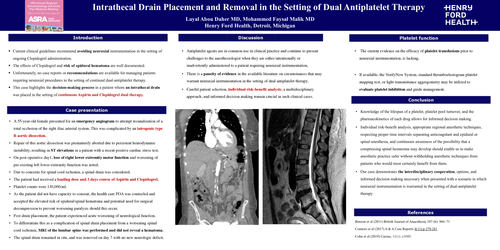
Current clinical guidelines recommend avoiding neuraxial instrumentation in the setting of ongoing Clopidogrel administration. The effects of Clopidogrel and risk of epidural hematoma are well documented. Unfortunately, no case reports or recommendations are available for managing patients requiring neuraxial procedures in the setting of continual dual-antiplatelet therapy. This case highlights the decision-making process in a patient whom an intrathecal drain was placed in the setting of continuous Aspirin and Clopidogrel dual therapy.
A 55-year-old female with a medical history significant for COPD, HTN, cocaine abuse, seizures, stroke with residual left-sided weakness and significant peripheral arterial disease, presented for an emergency angiogram to attempt recanalization of a total occlusion of the right iliac arterial system. This was complicated by an iatrogenic type B aortic dissection. Repair of this aortic dissection was prematurely aborted due to persistent hemodynamic instability, resulting in ST elevations in a patient with a known recent positive cardiac stress test. On post-operative day1, loss of right lower extremity motor function and worsening of pre-existing left lower extremity function was noted. Due to concerns for spinal cord ischemia, a spinal drain was considered. The patient had received both a loading dose and 3 days course of Aspirin and Clopidogrel by the time of spinal drain placement. Platelet counts were 130,000/ml. As the patient did not have capacity to consent, the health care POA was counseled and accepted the elevated risk of epidural/spinal hematoma and potential need for surgical decompression to prevent worsening paralysis should this occur. Post drain placement, the patient experienced acute worsening of neurological function. To differentiate this as a complication of spinal drain placement versus worsening spinal cord ischemia, a CT and MRI of the lumbar spine was performed and did not reveal a hematoma. Hence, the spinal drain remained in situ, and was removed on day 7 with no new neurologic deficits.
Antiplatelet agents are in common use in clinical practice and continue to present challenges to the anesthesiologist when they are either intentionally or inadvertently administered to a patient requiring neuraxial instrumentation. Unfortunately, there is a paucity of evidence in the available literature on circumstances that may warrant neuraxial instrumentation in the setting of dual antiplatelet therapy. In addition, the current evidence on the efficacy of platelet transfusions prior to neuraxial instrumentation, is lacking. If available, the VerifyNow System, standard thromboelastogram platelet mapping test, or light transmittance aggregometry may be utilized to evaluate platelet inhibition and guide management. Careful patient selection, individual risk-benefit analysis, a multidisciplinary approach, and informed decision making remain crucial in such a rare clinical case.