457 posters, 2 videos, 2 audios, 8 topics, 45 sessions, 401 authors, 265 institutions
ePostersLive by SciGen Technologies S.A. All rights reserved.
49th Annual Regional Anesthesiology and Acute Pain Medicine Meeting
March 21-23, 2024 | The Hilton Bayfront San Diego | San Diego, California

5578
FONTAN CIRCULATION AND NEURAXIAL ANESTHESIA: A CASE REPORT
Poster Presenter
Authors
Affiliations
Part of Topic
Medically Challenging Cases
BACKGROUND:
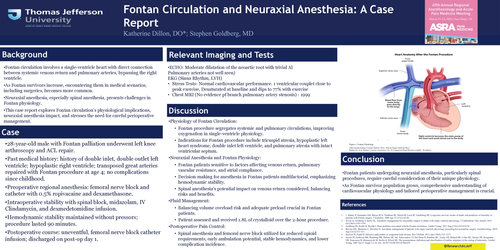
•Fontan circulation involves a single-ventricle heart with direct connection between systemic venous return and pulmonary arteries, bypassing the right ventricle.
•As Fontan survivors increase, encountering them in medical scenarios, including surgeries, becomes more common.
•Neuraxial anesthesia, especially spinal anesthesia, presents challenges in Fontan physiology.
•This case report explores Fontan circulation's physiological implications, neuraxial anesthesia impact, and stresses the need for careful perioperative management.
CASE
•28-year-old male with Fontan palliation underwent left knee arthroscopy and ACL repair.
•Past medical history: history of double inlet, double outlet left ventricle; hypoplastic right ventricle; transposed great arteries repaired with Fontan procedure at age 4; no complications since childhood.
•Preoperative regional anesthesia: femoral nerve block and catheter with 0.5% ropivacaine and dexamethasone.
•Intraoperative stability with spinal block, midazolam, IV Clindamycin, and dexmedetomidine infusion.
•Hemodynamic stability maintained without pressors; procedure lasted 90 minutes.
•Postoperative course: uneventful, femoral nerve block catheter infusion; discharged on post-op day 1.
IMAGING
•ECHO: Moderate dilatation of the neoartic root with trivial Al
Pulmonary arteries not well seen)
EKG (Sinus Rhythm, LVH)
•Stress Tests- Normal cardiovascular performance. 1 ventricular couplet close to peak exercise, Desaturated at baseline and dips to 77% with exercise
•Chest MRI (No evidence pf branch pulmonary artery stenosis) - 1999
DISCUSSION
•Physiology of Fontan Circulation:
•Fontan procedure segregates systemic and pulmonary circulations, improving oxygenation in single-ventricle physiology.
•Indications for Fontan procedure include tricuspid atresia, hypoplastic left heart syndrome, double inlet left ventricle, and pulmonary atresia with intact ventricular septum.
•Neuraxial Anesthesia and Fontan Physiology:
•Fontan patients sensitive to factors affecting venous return, pulmonary vascular resistance, and atrial compliance.
•Decision-making for anesthesia in Fontan patients multifactorial, emphasizing hemodynamic stability.
•Spinal anesthesia's potential impact on venous return considered, balancing risks and benefits.
•Fluid Management:
•Balancing volume overload risk and adequate preload crucial in Fontan patients.
•Patient assessed and received 1.8L of crystalloid over the 2-hour procedure.
•Postoperative Pain Control:
•Spinal anesthesia and femoral nerve block utilized for reduced opioid requirements, early ambulation potential, stable hemodynamics, and lower complication incidence.
CONCLUSION
•Fontan patients undergoing neuraxial anesthesia, particularly spinal procedures, require careful consideration of their unique physiology.
•As Fontan survivor population grows, comprehensive understanding of cardiovascular physiology and tailored perioperative management is crucial.