457 posters, 2 videos, 2 audios, 8 topics, 45 sessions, 401 authors, 265 institutions
ePostersLive by SciGen Technologies S.A. All rights reserved.
49th Annual Regional Anesthesiology and Acute Pain Medicine Meeting
March 21-23, 2024 | The Hilton Bayfront San Diego | San Diego, California

5213
LOCAL ANESTHETIC SYSTEMIC TOXICITY FROM UNINTENDED LIDOCAINE INGESTION
Poster Presenter
Authors
Affiliations
Part of Topic
Medically Challenging Cases
Local Anesthetic Systemic Toxicity from Unintended Lidocaine Ingestion
Lucas Richardson MD, John Alexander MD MBA
Department of Anesthesiology and Pain Management, UT Southwestern, Dallas, TX
Introduction
Local anesthetic systemic toxicity (LAST) is an uncommon but potentially life-threatening complication of local anesthetic use. Herein, we present a case of LAST caused by inadvertent ingestion of lidocaine solution.
Materials and Methods
As this case report is devoid of patient identifiable information, it is exempt from IRB review requirements as per UT Southwestern Medical Center policy.
Case Report
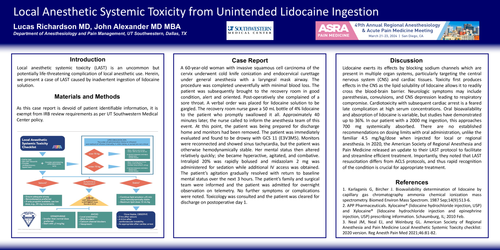
A 60-year-old woman with invasive squamous cell carcinoma of the cervix underwent cold knife conization and endocervical curettage under general anesthesia with a laryngeal mask airway. The procedure was completed uneventfully with minimal blood loss. The patient was subsequently brought to the recovery room in good condition, alert and oriented. Post-operatively she complained of a sore throat. A verbal order was placed for lidocaine solution to be gargled. The recovery room nurse gave a 50 mL bottle of 4% lidocaine to the patient who promptly swallowed it all. Approximately 40 minutes later, the nurse called to inform the anesthesia team of this event. At this point, the patient was being prepared for discharge home and monitors had been removed. The patient was immediately evaluated and found to be drowsy with GCS 11 (E3V3M5). Monitors were reconnected and showed sinus tachycardia, but the patient was otherwise hemodynamically stable. Her mental status then altered relatively quickly; she became hyperactive, agitated, and combative. Intralipid 20% was rapidly bolused and midazolam 2 mg was administered for sedation while additional IV access was obtained. The patient’s agitation gradually resolved with return to baseline mental status over the next 3 hours. The patient’s family and surgical team were informed and the patient was admitted for overnight observation on telemetry. No further symptoms or complications were noted. Toxicology was consulted and the patient was cleared for discharge on postoperative day 1.
Discussion
Lidocaine exerts its effects by blocking sodium channels which are present in multiple organ systems, particularly targeting the central nervous system (CNS) and cardiac tissues. Toxicity first produces effects in the CNS as the lipid solubility of lidocaine allows it to readily cross the blood-brain barrier. Neurologic symptoms may include paresthesias, convulsions, and CNS depression leading to respiratory compromise. Cardiotoxicity with subsequent cardiac arrest is a feared late complication at high serum concentrations. Oral bioavailability and absorption of lidocaine is variable, but studies have demonstrated up to 36%. In our patient with a 2000 mg ingestion, this approaches 700 mg systemically absorbed. There are no established recommendations on dosing limits with oral administration, unlike the familiar 4.5 mg/kg/dose when injected for local or regional anesthesia. In 2020, the American Society of Regional Anesthesia and Pain Medicine released an update to their LAST protocol to facilitate and streamline efficient treatment. Importantly, they noted that LAST resuscitation differs from ACLS protocols, and thus rapid recognition of the condition is crucial for appropriate treatment.
References
1. Karlaganis G, Bircher J. Bioavailability determination of lidocaine by capillary gas chromatography ammonia chemical ionization mass spectrometry. Biomed Environ Mass Spectrom. 1987 Sep;14(9):513-6.
2. APP Pharmaceuticals. Xylocaine® (lidocaine hydrochloride injection, USP) and Xylocaine® (lidocaine hydrochloride injection and epinephrine injection, USP) prescribing information. Schaumburg, IL; 2010 Feb.
3. Neal JM, Neal EJ, and Weinburg GL. American Society of Regional Anesthesia and Pain Medicine Local Anesthetic Systemic Toxicity checklist: 2020 version. Reg Anesth Pain Med 2021;46:81-82.