457 posters, 2 videos, 2 audios, 8 topics, 45 sessions, 401 authors, 265 institutions
ePostersLive by SciGen Technologies S.A. All rights reserved.
49th Annual Regional Anesthesiology and Acute Pain Medicine Meeting
March 21-23, 2024 | The Hilton Bayfront San Diego | San Diego, California

5608
ULTRASOUND GUIDED FEMORAL BRANCH BLOCK OF THE GENITOFEMORAL NERVE FOR FEMORAL ENDARTERECTOMY: A CASE REPORT
Poster Presenter
Authors
Affiliations
Part of Topic
Medically Challenging Cases
Femoral Branch Block Of The Genitofemoral Nerve For Femoral Endarterectomy: two challenging cases
Betke K.M., MD, PhD, Thum J., DO, Lunden N., MD
Department of Anesthesiology and Perioperative Medicine, Oregon Health & Science University, Portland OR
Introduction:
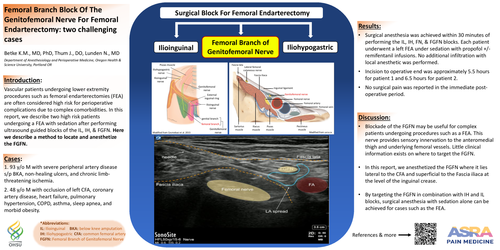
Vascular patients undergoing lower extremity procedures such as femoral endarterectomies (FEA) are often considered high risk for perioperative complications due to complex comorbidities. In this report, we describe two high risk patients undergoing a FEA with sedation after performing ultrasound guided blocks of the IL, IH, & FGFN. Here we describe a method to locate and anesthetize the FGFN.
Cases: 1. 93 y/o M with severe peripheral artery disease s/p BKA, non-healing ulcers, and chronic limb-threatening ischemia. 2. 48 y/o M with occlusion of left CFA, coronary artery disease, heart failure, pulmonary hypertension, COPD, asthma, sleep apnea, and morbid obesity.
Results: Surgical anesthesia was achieved within 30 minutes of performing the IL, IH, FN, & FGFN blocks. Each patient underwent a left FEA under sedation with propofol +/- remifentanil infusions. No additional infiltration with local anesthetic was performed. Incision to operative end was approximately 5.5 hours for patient 1 and 6.5 hours for patient 2. No surgical pain was reported in the immediate post-operative period.
Discussion: Blockade of the FGFN may be useful for complex patients undergoing procedures such as a FEA. This nerve provides sensory innervation to the anteromedial thigh and underlying femoral vessels. Little clinical information exists on where to target the FGFN. In this report, we anesthetized the FGFN where it lies lateral to the CFA and superficial to the Fascia iliaca at the level of the inguinal crease. By targeting the FGFN in combination with IH and IL blocks, surgical anesthesia with sedation alone can be achieved for cases such as the FEA.