457 posters, 2 videos, 2 audios, 8 topics, 45 sessions, 401 authors, 265 institutions
ePostersLive by SciGen Technologies S.A. All rights reserved.
49th Annual Regional Anesthesiology and Acute Pain Medicine Meeting
March 21-23, 2024 | The Hilton Bayfront San Diego | San Diego, California

5579
DELAYED EPIDURAL SPREAD FOLLOWING LUMBAR ERECTOR SPINAE PLANE BLOCK IN THE SETTING OF HYPOPLASTIC FACET JOINTS
Poster Presenter
Authors
Affiliations
Part of Topic
Medically Challenging Cases
Abstract Title: Delayed epidural spread following lumbar erector spinae plane block in the setting of hypoplastic facet joints
Submitting Author Details: Priyanka Shetty, DO
Co Author Details:
Benjamin Kong, MD
Edan Bashkin, DO
Rebecca Christensen, MD
Kevin Finkel, MD, FASA
Introduction:
Erector spinae plane blocks are commonly used analgesic adjuncts for a variety of operations. At our institution we routinely perform preoperative bilateral lumbar erector spinae plane blocks for all posterior lumbar spine surgeries. Although the majority of these blocks occur without issue, we present a case of epidural spread in the setting of unilateral hypoplastic facet joints.
Methods and Materials:
We performed a retrospective review of one case and a literature review on the topic. The patient provided consent for this case to be written up. Given that the case report does not include identifiable patient information, it is exempt from IRB review requirements per Hartford Healthcare policy.
Case Report:
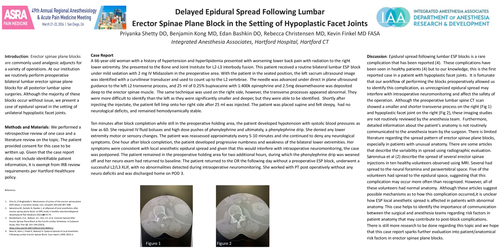
A 66-year-old woman with a history of hypertension and hyperlipidemia presented with worsening lower back pain with radiation to the right lower extremity. She presented to the Bone and Joint Institute for L2-L3 interbody fusion. This patient received a routine bilateral lumbar ESP block under mild sedation with 2 mg IV Midazolam in the preoperative area. With the patient in the seated position, the left sacrum ultrasound image was identified with a curvilinear transducer and used to count up to the L2 vertebrae. The needle was advanced under direct in plane ultrasound guidance to the left L2 transverse process, and 25 ml of 0.25% bupivacaine with 1:400k epinephrine and 2.5mg dexamethasone was deposited deep to the erector spinae muscle. The same technique was used on the right side, however, the transverse processes appeared abnormal. They were more difficult to identify than the left as they were significantly smaller and deeper, but they were able to be identified. Shortly after injecting the injectate, the patient fell limp onto her right side after 25 ml was injected. The patient was placed supine and felt sleepy, had no neurological deficits, and remained hemodynamically stable.
Ten minutes after block completion while still in the preoperative holding area, the patient developed hypotension with systolic blood pressures as low as 60. She required IV fluid boluses and high dose pushes of phenylephrine and ultimately, a phenylephrine drip. She denied any lower extremity motor or sensory changes. The patient was reassessed approximately every 5-10 minutes and she continued to deny any neurological symptoms. One hour after block completion, the patient developed progressive numbness and weakness of the bilateral lower extremities. Her symptoms were consistent with local anesthetic epidural spread and given that this would interfere with intraoperative neuromonitoring, the case was postponed. The patient remained in the preoperative holding area for two additional hours, during which the phenylephrine drip was weaned off and her neuro exam had returned to baseline. The patient returned to the OR the following day without a preoperative ESP block, underwent a successful L2/L3 XLIF, with no abnormalities detected during intraoperative neuromonitoring. She worked with PT post operatively without any neuro deficits and was discharged home on POD 3.
Discussion:
Epidural spread following lumbar ESP blocks is a rare complication that has been reported (4). These complications have been seen in healthy patients (4) but to our knowledge, this is the first reported case in a patient with hypoplastic facet joints. It is fortunate that our workflow of performing the blocks preoperatively allowed us to identify this complication, as unrecognized epidural spread may interfere with intraoperative neuromonitoring and affect the safety of the operation. Although the preoperative lumbar spine CT scan showed a smaller and shorter transverse process on the right (Fig 1) and hypoplastic facet joint on the right (Fig 2), these imaging studies are not routinely reviewed by the anesthesia team. Furthermore, detailed information about the patient’s anatomy is not routinely communicated to the anesthesia team by the surgeon.
There is limited literature regarding the spread pattern of erector spinae plane blocks, especially in patients with unusual anatomy. There are some articles that describe the variability in spread using radiographic evaluation. Sørenstua et al (2) describe the spread of several erector spinae injections in ten healthy volunteers observed using MRI. Several had spread to the neural foramina and paravertebral space. Five of the volunteers had spread to the epidural space, suggesting that this complication may occur more often than recognized. However, all of these volunteers had normal anatomy.
Although these articles suggest possible mechanisms as to how this complication occurred,it is unclear how ESP local anesthetic spread is affected in patients with abnormal anatomy. This case helps to identify the importance of communication between the surgical and anesthesia teams regarding risk factors in patient anatomy that may contribute to post-block complications. There is still more research to be done regarding this topic and we hope that this case report sparks further evaluation into patient/anatomical risk factors in erector spinae plane blocks.
References:
-
Chin KJ, El-Boghdadly K. Mechanisms of action of the erector spinae plane (ESP) block: a narrative review. Can J Anaesth 2021;68:387–408.
-
Sørenstua M, Zantalis N, Raeder J, et alSpread of local anesthetics after erector spinae plane block: an MRI study in healthy volunteersRegional Anesthesia & Pain Medicine 2023;48:74-79.
-
Breidenbach, K.A., Wahezi, S.E., Kim, S.Y. et al. Contrast Spread After Erector Spinae Plane Block at the Fourth Lumbar Vertebrae: A Cadaveric Study. Pain Ther12, 241–249 (2023). https://doi.org/10.1007/s40122-022-00453-2
-
Mani N, Sehn J, Finkel K, Makanji H. Epidural Spread of Local Anesthetic Following Lumbar Erector Spinae Block. Case report, ASRA 2022.in