457 posters, 2 videos, 2 audios, 8 topics, 45 sessions, 401 authors, 265 institutions
ePostersLive by SciGen Technologies S.A. All rights reserved.
49th Annual Regional Anesthesiology and Acute Pain Medicine Meeting
March 21-23, 2024 | The Hilton Bayfront San Diego | San Diego, California

5228
INTRATHECAL MORPHINE FOR PAIN CONTROL IN THREE PATIENTS UNDERGOING DEEP INFERIOR EPIGASTRIC FLAP BREAST RECONSTRUCTION
Poster Presenter
Authors
Affiliations
Part of Topic
Medically Challenging Cases
Intrathecal Morphine in Patients Undergoing Deep Inferior Epigastric Flap Breast Reconstruction
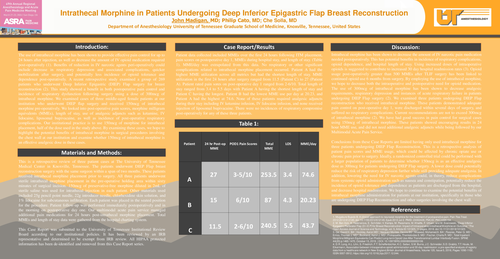
The use of intrathecal morphine has been shown to provide effective pain control for up to 24 hours after injection, as well as decrease the amount of IV opioid medication required post-operatively (1). Benefits of reduction in IV narcotic agents peri-operatively could include decrease in respiratory depression and associated complications, quicker mobilization after surgery, and potentially less incidence of opioid tolerance and dependence post-operatively. A recent retrospective study examined a group of 269 patients who underwent Deep Inferior Epigastric (DIEP) Flap surgery for breast reconstruction (2). This study showed a benefit in both postoperative pain control and incidence of respiratory dysfunction following surgery using a dose of 300mcg of intrathecal morphine. We examined cases of three middle-aged female patients at our institution who underwent DIEP flap surgery and received 150mcg of intrathecal morphine pre-operatively. We looked into post-operative pain scores, morphine milligram equivalents (MMEs), length of stay, use of analgesic adjuncts such as ketamine, IV lidocaine, liposomal bupivacaine, as well as incidence of post-operative respiratory complications. Our institutional practice is to use 150mcg of morphine for intrathecal placement, half of the dose used in the study above. By examining these cases, we hope to highlight the potential benefits of intrathecal morphine in surgical procedures involving the chest wall at our institution and examine whether 150mcg of intrathecal morphine is an effective analgesic dose in these cases.