457 posters, 2 videos, 2 audios, 8 topics, 45 sessions, 401 authors, 265 institutions
ePostersLive by SciGen Technologies S.A. All rights reserved.
49th Annual Regional Anesthesiology and Acute Pain Medicine Meeting
March 21-23, 2024 | The Hilton Bayfront San Diego | San Diego, California

5129
A NEW BLOCK FOR CHEST TUBE PAIN: INTRODUCING THE ULTRASOUND-GUIDED ENDOTHORACIC FASCIAL PLANE BLOCK
Poster Presenter
Authors
Affiliations
Part of Topic
Medically Challenging Cases
A New Block for Chest Tube Pain: Introducing the Ultrasound- Guided Endothoracic Fascial Plane Block
Mehrafza, M, de Haan JB, Jacoby K, Khan S, Campbell AN, Gosey B, Merutka N, Hernandez N
University of Texas Health Science Center at Houston
Department of Anesthesiology, Critical Care, and Pain Medicine
-
Severe pain from thoracostomy tubes can be difficult to control with standard multimodal pain regimens.
-
Poorly controlled acute thoracic pain is associated with decreased quality of recovery, hemodynamic and pulmonary complications, and increased healthcare expenditures (1).
-
Extrapleural nerve blocks with dissection and intraoperative catheter placement by surgeons have been described in the literature and have demonstrated comparable pain relief to thoracic epidural analgesia (5).
-
We report the novel description of an ultrasound-guided technique with a single injection into this extrapleural plane in a series of patients that successfully treated severe thoracostomy tube pain for 24 hours or more.
Two patients were identified as having severe pain due to chest tube thoracostomy. The endothoracic fascial plane block was performed with 30 mL of bupivicaine and 5 mg of dexamethasone at each injection site. Both patients almost immediately noted significant reduction in pain around the chest tube sites which lasted approximately 24 hours. The patients' demographics, pain location and are detailed in the table 1.
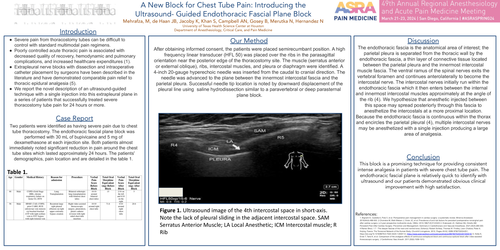
After obtaining informed consent, the patients were placed semirecumbant position. A high frequency linear transducer (HFL 50) was placed over the ribs in the parasagittal orientation near the posterior edge of the thoracostomy site. The muscle (serratus anterior or external oblique), ribs, intercostal muscles, and pleura or diaphragm were identified. A 4-inch 20-gauge hyperechoic needle was inserted from the caudal to cranial direction. The needle was advanced to the plane between the innermost intercostal fascia and the parietal pleura. Successful needle tip location is noted by downward displacement of the pleural line using saline hydrodissection similar to a paravertebral or deep parasternal plane block.
The endothoracic fascia is the anatomical area of interest; the parietal pleura is separated from the thoracic wall by the endothoracic fascia, a thin layer of connective tissue located between the parietal pleura and the innermost intercostal muscle fascia. The ventral ramus of the spinal nerves exits the vertebral foramen and continues anterolaterally to become the intercostal nerve. The intercostal nerves initially run within the endothoracic fascia which it then enters between the internal and innermost intercostal muscles approximately at the angle of the rib (4). We hypothesize that anesthetic injected between this space may spread posteriorly through this fascia to anesthetize the intercostals at a more proximal location. Because the endothoracic fascia is continuous within the thorax and encircles the parietal pleural (4), multiple intercostal nerves may be anesthetized with a single injection producing a large area of analgesia.
This block is a promising technique for providing consistent intense analgesia in patients with severe chest tube pain. The endothoracic fascial plane is relatively quick to identify with ultrasound and our patients demonstrated obvious clinical improvement with high satisfaction.