457 posters, 2 videos, 2 audios, 8 topics, 45 sessions, 401 authors, 265 institutions
ePostersLive by SciGen Technologies S.A. All rights reserved.
49th Annual Regional Anesthesiology and Acute Pain Medicine Meeting
March 21-23, 2024 | The Hilton Bayfront San Diego | San Diego, California

5469
AXILLARY BLOCK IN SITTING POSITION FOR URGENT AV FISTULA REVISION IN AN UNSTABLE PATIENT
Poster Presenter
Authors
Affiliations
Part of Topic
Medically Challenging Cases
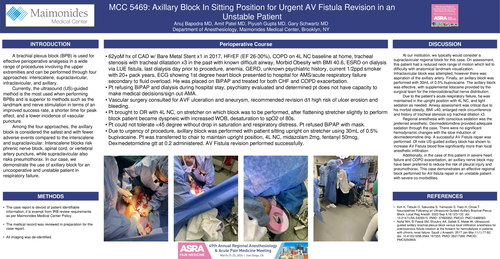
MCC 5469: Axillary Block In Sitting Position for Urgent AV Fistula Revision in an Unstable Patient
Anuj Bapodra MD, Amit Patel MD, Piyush Gupta MD, Gary Schwartz MD
Department of Anesthesiology, Maimonides Medical Center, Brooklyn, NY
A brachial plexus block (BPB) is used for effective perioperative analgesia in a wide range of procedures involving the upper extremities and can be performed through four approaches: interscalene, supraclavicular, infraclavicular, and axillary.
Currently, the ultrasound (US)-guided method is the most used when performing BPBs and is superior to methods such as the landmark and nerve stimulation in terms of an improved success rate, a shorter time for peak effect, and a lower incidence of vascular puncture.
Among the four approaches, the axillary block is considered the safest and with fewer adverse events compared to the interscalene and supraclavicular. Interscalene blocks risk phrenic nerve block, spinal cord, or vertebral artery puncture, while supraclavicular also risks pneumothorax. In our case, we demonstrate the use of axillary block for an uncooperative and unstable patient in respiratory failure.
At our institution, we typically would consider a supraclavicular regional block for this case. On assessment, this patient had a reduced neck range of motion which led to difficulty with anatomical landmark visualization. Infraclavicular block was attempted, however there was aspiration of the axillary artery. Finally, an axillary block was performed with 30mL of 0.5% bupivacaine. The axillary block was effective, with supplemental lidocaine provided by the surgical team for the intercostobrachial nerve distribution.
Due to the patient’s acute respiratory failure, he was maintained in the upright position with 4L NC, and light sedation as needed. Airway assessment was critical due to his morbid obesity, BMI >40, enlarged neck circumference and history of tracheal stenosis s/p tracheal dilation x3. Regional anesthesia with conscious sedation was the preferred anesthetic. Dexmedetomidine provided adequate sedation through the case. There were no significant hemodynamic changes with the slow induction of dexmedetomidine drip. A successful AV Fistula repair was performed. Of note US-guided axillary block has shown to increase AV Fistula blood flow significantly more than local anesthetic infiltration.
Additionally, in the case of this patient in severe heart failure and COPD exacerbation, an axillary nerve block may have been preferred to reduce the risk of pleural injury and pneumothorax. This case demonstrates an effective regional block performed for AV-fistula repair in an unstable patient with severe co-morbidities.