457 posters, 2 videos, 2 audios, 8 topics, 45 sessions, 401 authors, 265 institutions
ePostersLive by SciGen Technologies S.A. All rights reserved.
49th Annual Regional Anesthesiology and Acute Pain Medicine Meeting
March 21-23, 2024 | The Hilton Bayfront San Diego | San Diego, California

5099
NEURAXIAL ANESTHESIA IN PREGNANT PATIENT WITH INTRACRANIAL HYPERTENSION
Poster Presenter
Authors
Affiliations
Part of Topic
Medically Challenging Cases
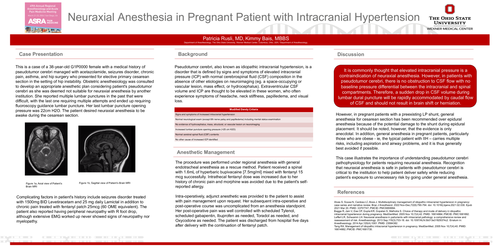
This is a case of a 38-year-old G1P0000 female with a medical history of pseudotumor cerebri managed with acetazolamide, seizures disorder, chronic pain, asthma, and hip surgery who presented for elective primary cesarean section in the setting of hip instability. Obstetric anesthesiology was consulted to develop an appropriate anesthetic plan considering patient's pseudotumor cerebri as she was deemed not suitable for neuraxial anesthesia by another institution. She reported multiple lumbar punctures in the past that were difficult, with the last one requiring multiple attempts and ended up requiring fluoroscopy guidance lumbar puncture. Her last lumbar puncture opening pressure was 22cm H2O. The patient desired neuraxial anesthesia to be awake during the cesarean section.
Complicating factors in patient's history include seizures disorder treated with 1500mg BID Levetiracetam and 25 mg daily Lamictal in addition to chronic pain treated with fentanyl patch 25mcg (60 OME equivalent). The patient also reported having peripheral neuropathy with R foot drop, although extensive EMG worked up never showed signs of neuropathy nor myelopathy.
Pseudotumor cerebri, also known as idiopathic intracranial hypertension, is a disorder that is defined by signs and symptoms of elevated intracranial pressure (ICP) with normal cerebrospinal fluid (CSF) composition in the absence of other etiologies on neuroimaging (eg. a space-occupying or vascular lesion, mass effect, or hydrocephalus). Extraventricular CSF volume and ICP are thought to be elevated in these women, who often experience symptoms of headache, neck stiffness, papilledema, and visual loss.
The procedure was performed under regional anesthesia with general endotracheal anesthesia as a rescue method. Patient received a spinal with 1.6mL of hyperbaric bupivacaine [7.5mg/ml] mixed with fentanyl 15 mcg successfully. Intrathecal fentanyl dose was increased due to her history of chronic pain and morphine was avoided due to the patient's self- reported allergy.
Intra-operatively, adjunct anesthetic was provided to the patient to assist with pain management upon request. Her subsequent intra-operative and post-operative course was uncomplicated from an anesthesia standpoint. Her post-operative pain was well controlled with scheduled Tylenol, scheduled gabapentin, Ibuprofen as needed, Toradol as needed, and Oxycodone as needed. The patient was discharged from hospital five days after delivery with the continuation of fentanyl patch.
It is commonly thought that elevated intracranial pressure is a contraindication of neuraxial anesthesia. However, in patients with pseudotumor cerebri, there is no obstruction to CSF flow with no baseline pressure differential between the intracranial and spinal compartments. Therefore, a sudden drop in CSF volume during lumbar dural puncture will be rapidly accommodated by caudal flow of CSF and should not result in brain shift or herniation.
However, in pregnant patients with a preexisting LP shunt, general anesthesia for cesarean section has been recommended over epidural anesthesia because of the potential damage to the shunt during epidural placement. It should be noted, however, that the evidence is only anecdotal. In addition, general anesthesia in pregnant patients, particularly those who are obese - ie, the typical patient with IIH – carries multiple risks, including aspiration and airway problems, and it is thus generally best avoided if possible.
This case illustrates the importance of understanding pseudotumor cerebri pathophysiology for patients requiring neuraxial anesthesia. Recognition that neuraxial anesthesia is safe in patients with pseudotumor cerebri is critical to the institution to help patient deliver safely while reducing patient’s exposure to unnecessary risk by going under general anesthesia.