457 posters, 2 videos, 2 audios, 8 topics, 45 sessions, 401 authors, 265 institutions
ePostersLive by SciGen Technologies S.A. All rights reserved.
49th Annual Regional Anesthesiology and Acute Pain Medicine Meeting
March 21-23, 2024 | The Hilton Bayfront San Diego | San Diego, California

5423
INTERSCALENE NERVE BLOCK FOR POST-OPERATIVE PAIN MANAGEMENT FOLLOWING FOREQUARTER AMPUTATION
Poster Presenter
Authors
Affiliations
Part of Topic
Medically Challenging Cases
Interscalene Nerve Block for Postoperative Pain Following Forequarter Amputation
M. Austin Bowyer, MD; Dustin Smith, MD; James Beckham III, MD
Department of Anesthesiology University of Tennessee Graduate School of Medicine, Knoxville, Tennessee, United States
Introduction:
Forequarter amputations are a procedure that were first described in 1887 in the setting of traumatic injury. It involves the amputation of upper extremity, scapula, and clavicle. Dimas indicated that “with the advent of limb-sparing techniques, primary forequarter amputation is performed less frequently […] the most frequent indications are presence of malignant tumors of the arm, axilla, shoulder and scapula.”1 Because the surgical area for this radical procedure includes innervation from cervical plexus, brachial plexus, and thoracic nerve roots, regional anesthetic pain management strategies can be challenging.
Case Report:
Patient informed consent was obtained for all the case presented. Additionally, this case is devoid of patient identifiable information, it is exempt from IRB review requirements as per UTMCK policy.
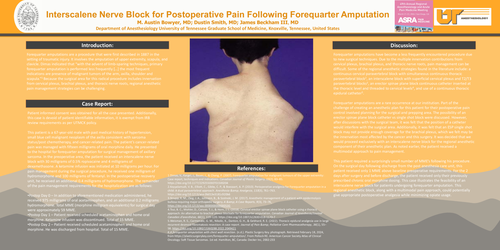
This patient is a 67-year-old male with past medical history of hypertension, small blue cell malignant neoplasm of the axilla consistent with sarcoma status/post chemotherapy, and cancer-related pain. The patient’s cancer-related pain was managed with fifteen milligrams of oral morphine daily. He presented to the hospital for forequarter amputation for surgical management of axillary sarcoma. In the preoperative area, the patient received an interscalene nerve block with 30 milligrams of 0.5% ropivacaine and 4 milligrams of dexamethasone. A ketamine infusion was initiated at 10 milligrams per hour. For pain management during the surgical procedure, he received one milligram of hydromorphone and 100 milligrams of fentanyl. In the postoperative recovery unit, he received an additional 0.4 milligrams of hydromorphone. The remainder of the pain management requirements for the hospitalization are as follows:
Forequarter amputations have become a less frequently encountered procedure due to new surgical techniques. Due to the multiple innervation contributions from cervical plexus, brachial plexus, and thoracic nerve roots, pain management can be difficult. Some of the regional anesthetic strategies found in the literature include: a continuous cervical paravertebral block with simultaneous continuous thoracic paravertebral block2, an interscalene block with superficial cervical plexus and T2/T3 paravertebral blocks3, an erector spinae plane block continuous catheter inserted at the thoracic level and threaded to cervical levels4, and use of a continuous thoracic epidural catheter5.
Forequarter amputations are a rare occurrence at our institution. Part of the challenge of creating an anesthetic plan for this patient for their postoperative pain control involved planning for the surgical and prepping area. The possibility of an erector spinae plane block catheter vs single shot block were discussed. However, after discussions with the surgical team, it was felt that the position of a catheter would interfere with the surgical area. Additionally, it was felt that an ESP single shot block may not provide enough coverage for the brachial plexus, which we felt may be the innervation most affected by the cancer and this surgery. It was decided that we would proceed exclusively with an interscalene nerve block for the regional anesthetic component of their anesthetic plan. As noted earlier, the patient received a multimodal approach to pain management.
This patient required a surprisingly small number of MME’s following his procedure. On the surgical day following discharge from the post anesthesia care unit, this patient received only 1 MME above baseline preoperative requirements. For the 2 days after surgery and before discharge, the patient received only their previously prescribed chronic oral morphine dosing. This case illustrates the feasibility of an interscalene nerve block for patients undergoing forequarter amputation. This regional anesthetic block, along with a multimodal pain approach, could potentially give appropriate postoperative analgesia while minimizing opiate usage.
References: