457 posters, 2 videos, 2 audios, 8 topics, 45 sessions, 401 authors, 265 institutions
ePostersLive by SciGen Technologies S.A. All rights reserved.
49th Annual Regional Anesthesiology and Acute Pain Medicine Meeting
March 21-23, 2024 | The Hilton Bayfront San Diego | San Diego, California

5403
REGIONAL ANESTHESIA FOR ARTHROSCOPIC KNEE REPAIR IN PATIENT WITH HOCM UNDER MONITORED ANESTHESIA CARE WITH DEXMEDETOMIDINE.
Poster Presenter
Authors
Affiliations
Part of Topic
Medically Challenging Cases
Regional anesthesia for arthroscopic knee repair in patient with HOCM under monitored anesthesia care with dexmedetomidine: A Case Report
Julie J. Cunningham1, Andrew S. Braun2, Promil Kukreja2
1 Heersink School of Medicine, University of Alabama at Birmingham, Birmingham, AL, USA
2 Department of Anesthesiology and Perioperative Medicine, University of Alabama at Birmingham, Birmingham, AL, USA
Background
Hypertrophic Obstructive Cardiomyopathy (HOCM):
• Most common inherited cardiac malformation (1/500 adults).1
• Perioperative goals: maintain volume status, systemic vascular resistance, avoid tachycardia, reduce contractility, and select agents with minimal sympathetic effects.1
Regional Anesthesia (RA):
• Minimizes hemodynamic fluctuations, avoids intubation, reduces pharmacologic side effects, enhances recovery after surgery, and greater patient satisfaction.2
Dexmedetomidine (DEX):
• Highly selective alpha-2 adrenergic agonist
• Indirect and direct cardioprotective effects, minimal respiratory depression, reduced sympathetic response, anxiolysis, sedation, and analgesia.3,4
Case Description
• 15-year-old female with HOCM, mild cognitive delay, seasonal asthma, and obesity came to UAB for a right knee arthroscopy for patellar instability
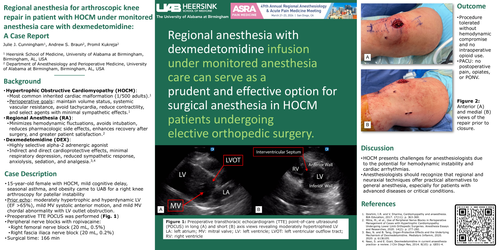
• Prior echo: moderately hypertrophic and hyperdynamic LV (EF >65%), mild MV systolic anterior motion, and mild MV chordal abnormality with LV outlet obstruction.
• Preoperative TTE POCUS was performed (Fig. 1)
• Peripheral nerve blocks with ropivacaine:
• Right femoral nerve block (20 mL, 0.5%)
• Right fascia iliaca nerve block (20 mL, 0.2%)
• Surgical time: 166 min
Outcome
• Procedure tolerated without hemodynamic compromise and no intraoperative opioid use.
• PACU: no postoperative pain, opiates, or PONV.
Discussion
• HOCM presents challenges for anesthesiologists due to the potential for hemodynamic instability and cardiac arrhythmias.
• Anesthesiologists should recognize that regional and neuraxial techniques offer practical alternatives to general anesthesia, especially for patients with advanced diseases or critical conditions.
Regional anesthesia with dexmedetomidine infusion under monitored anesthesia care can serve as a prudent and effective option for surgical anesthesia in HOCM patients undergoing elective orthopedic surgery.