457 posters, 2 videos, 2 audios, 8 topics, 45 sessions, 401 authors, 265 institutions
ePostersLive by SciGen Technologies S.A. All rights reserved.
49th Annual Regional Anesthesiology and Acute Pain Medicine Meeting
March 21-23, 2024 | The Hilton Bayfront San Diego | San Diego, California

5395
MANAGING MULTIPLE COMORBIDITIES AND TIBIAL FRACTURE WITH REGIONAL ANESTHESIA TECHNIQUES: A CASE REPORT
Poster Presenter
Authors
Affiliations
Part of Topic
Medically Challenging Cases
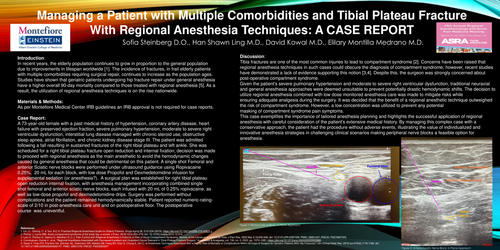
Managing a Patient with Multiple Comorbidities and Tibial Plateau Fracture With Regional Anesthesia Techniques: A CASE REPORT
Sofia Steinberg D.O., Han Shawn Ling M.D., David Kowal M.D., Elilary Montilla Medrano M.D.
Introduction:
In recent years, the elderly population continues to grow in proportion to the general population due to improvements in lifespan worldwide [1]. The incidence of fractures, in frail elderly patients with multiple comorbidities requiring surgical repair, continues to increase as the population ages. Studies have shown that geriatric patients undergoing hip fracture repair under general anesthesia have a higher overall 90-day mortality compared to those treated with regional anesthesia [5]. As a result, the utilization of regional anesthesia techniques is on the rise nationwide.
Materials & Methods:
As per Montefiore Medical Center IRB guidelines an IRB approval is not required for case reports.
Case Report:
A 73-year-old female with a past medical history of hypertension, coronary artery disease, heart failure with preserved ejection fraction, severe pulmonary hypertension, moderate to severe right ventricular dysfunction, interstitial lung disease managed with chronic steroid use, obstructive sleep apnea, atrial fibrillation, and chronic kidney disease stage III. The patient was admitted following a fall resulting in sustained fractures of the right tibial plateau and left ankle. She was scheduled for a right tibial plateau fracture open reduction and internal fixation; decision was made to proceed with regional anesthesia as the main anesthetic to avoid the hemodynamic changes caused by general anesthesia that could be detrimental on this patient. A single shot Femoral and anterior Sciatic nerve blocks were performed under ultrasound guidance using Ropivacaine 0.25%, 20 mL for each block, with low dose Propofol and Dexmedetomidine infusion for supplemental sedation (or anesthesia?). A surgical plan was established for right tibial plateau open reduction internal fixation, with anesthesia management incorporating combined single shot femoral and anterior sciatic nerve blocks, each infused with 20 mL of 0.25% ropivacaine, as well as low-dose propofol and dexmedetomidine drips. Surgery was performed without complications and the patient remained hemodynamically stable. Patient reported numeric-rating-scale of 2/10 in post-anesthesia care unit and on postoperative floor. The postoperative course was uneventful.
Discussion:
Tibia fractures are one of the most common injuries to lead to compartment syndrome [2]. Concerns have been raised that regional anesthesia techniques in such cases could obscure the diagnosis of compartment syndrome; however, recent studies have demonstrated a lack of evidence supporting this notion [3,4]. Despite this, the surgeon was strongly concerned about post-operative compartment syndrome.
Given the patient's severe pulmonary hypertension and moderate to severe right ventricular dysfunction, traditional neuraxial and general anesthesia approaches were deemed unsuitable to prevent potentially drastic hemodynamic shifts. The decision to utilize regional anesthesia combined with low dose monitored anesthesia care was made to mitigate risks while
ensuring adequate analgesia during the surgery. It was decided that the benefit of a regional anesthetic technique outweighed the risk of compartment syndrome. However, a low concentration was utilized to prevent any potential masking of compartment syndrome pain symptoms.
This case exemplifies the importance of tailored anesthesia planning and highlights the successful application of regional anesthesia with careful consideration of the patient's extensive medical history. By managing this complex case with a conservative approach, the patient had the procedure without adverse events, illustrating the value of individualized and innovative anesthesia strategies in challenging clinical scenarios making peripheral nerve blocks a feasible option for anesthesia.