457 posters, 2 videos, 2 audios, 8 topics, 45 sessions, 401 authors, 265 institutions
ePostersLive by SciGen Technologies S.A. All rights reserved.
49th Annual Regional Anesthesiology and Acute Pain Medicine Meeting
March 21-23, 2024 | The Hilton Bayfront San Diego | San Diego, California

5507
DIAGNOSTIC ENIGMA: A CASE OF PROGRESSIVE BACLOFEN WITHDRAWAL DUE TO BACLOFEN PUMP MALFUNCTION
Poster Presenter
Authors
Affiliations
Part of Topic
Medically Challenging Cases
Introduction
-
Intrathecal baclofen administration via an implanted delivery system is a popular FDA-approved treatment for disabling spasticity that ensures elevated drug concentrations in the cerebrospinal fluid, enhancing therapeutic efficacy.1
-
Pump or catheter malfunction can result in an abrupt cessation of baclofen therapy leading to a potentially life threatening withdrawal symptom.
-
Baclofen withdrawal typically manifests as a sudden resurgence of baseline spasticity, often accompanied by seizures, rhabdomyolysis, hyperthermia, confusion, hallucinations, or paresthesia.2
-
Although most manifests acutely, in our case we see an unusual presentation of prolonged baclofen withdrawal, attributed to catheter-related pump malfunction.
-
Informed consent was obtained from the patient's legal guardian, who provided consent to present the patient's case in a de-identified manner. The case report lacks patient-identifiable information, exempting it from IRB review requirements per Yale University policy.
-
13-year-old male with a history of Lesch-Nyhan syndrome and spastic quadriplegia managed by an intrathecal baclofen pump presented to the ED with complaints of fever, rapid breathing, and progressive worsening of muscular pain and spasticity in the preceding months.
-
Vitals = 103.3 F, HR 80 bpm, BP 140/70 mmHg, RR 63 bpm, and SpO2 91% on RA
-
Labs = elevated creatinine kinase, leukocytosis, positive influenza A, and a positive urine culture
-
The patient was admitted for further management.
-
Day 1 of hospitalization:
-
Interrogation of the baclofen pump yielded unremarkable.
-
With an unremarkable interrogation, gradual worsening spasticity, and an infectious cause identified, the team felt pump malfunction was unlikely.
-
Treatment focused on medical management of the underlying infection and, for his spasticity, an up-titration of his home diazepam and intrathecal baclofen basal rate.
-
Day 5 of hospitalization:
-
Despite his infection resolving with antibiotics, creatine kinase continued to rise and spasticity remained unchanged.
-
Repeat pump interrogation was unremarkable. Port aspiration was performed and negative for cerebrospinal fluid.
-
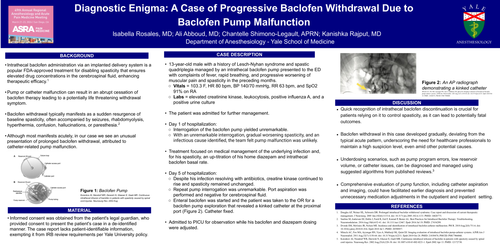
Enteral baclofen was started and the patient was taken to the OR for a baclofen pump exploration that revealed a kinked catheter at the proximal port (Figure 2). Catheter fixed.
-
Admitted to PICU for observation while his baclofen and diazepam dosing were adjusted.
-
Quick recognition of intrathecal baclofen discontinuation is crucial for patients relying on it to control spasticity, as it can lead to potentially fatal outcomes.
-
Baclofen withdrawal in this case developed gradually, deviating from the typical acute pattern, underscoring the need for healthcare professionals to maintain a high suspicion level, even amid other potential causes.
-
Underdosing scenarios, such as pump program errors, low reservoir volume, or catheter issues, can be diagnosed and managed using suggested algorithms from published reviews.3
-
Comprehensive evaluation of pump function, including catheter aspiration and imaging, could have facilitated earlier diagnosis and prevented unnecessary medication adjustments in the outpatient and inpatient setting.