457 posters, 2 videos, 2 audios, 8 topics, 45 sessions, 401 authors, 265 institutions
ePostersLive by SciGen Technologies S.A. All rights reserved.
49th Annual Regional Anesthesiology and Acute Pain Medicine Meeting
March 21-23, 2024 | The Hilton Bayfront San Diego | San Diego, California

5238
ANESTHETIC MANAGEMENT FOR TOTAL HIP REPLACEMENT IN A PATIENT WITH AVASCULAR NECROSIS SECONDARY TO ANTISYNTHETASE SYNDROME
Poster Presenter
Authors
Affiliations
Part of Topic
Medically Challenging Cases
Anesthetic Management of Patient with Avascular Necrosis Secondary to Anti-synthetase Syndrome undergoing Total Hip Replacement
Jasper Yan, MD, MPH; Danielle Ludwin, MD
Department of Anesthesiology, Columbia University
INTRO
•Anti-synthetase syndrome is an idiopathic inflammatory myopathy (IIM) characterized by auto-antibodies directed at aminoacyl-tRNA synthetase
•Due to the rarity of this condition, the optimal anesthetic strategy has not been defined
METHODS
•Retrospective analysis of a patient who received standard-of-care medical attention, with written informed consent
CASE REPORT
•48M w/anti-synthetase syndrome treated with high-dose immunosuppression (e.g., steroids) complicated by avascular necrosis, now presenting for total hip replacement
•Notable comorbidities included significant cervical stenosis with radiculopathy and adrenal insufficiency
•Physical exam and laboratory findings were otherwise unremarkable
•Anesthetic management was uncomplicated with single-shot L3-L4 spinal with 14 mg ropivacaine and deep sedation
DISCUSSION
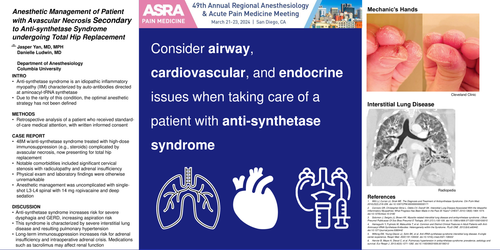
•Anti-synthetase syndrome increases risk for severe dysphagia and GERD, increasing aspiration risk
•This syndrome is characterized by severe interstitial lung disease and resulting pulmonary hypertension
•Long-term immunosuppression increases risk for adrenal insufficiency and intraoperative adrenal crisis. Medications such as tacrolimus may affect renal function