457 posters, 2 videos, 2 audios, 8 topics, 45 sessions, 401 authors, 265 institutions
ePostersLive by SciGen Technologies S.A. All rights reserved.
49th Annual Regional Anesthesiology and Acute Pain Medicine Meeting
March 21-23, 2024 | The Hilton Bayfront San Diego | San Diego, California

5448
ANESTHETIC MANAGEMENT FOR HIP FRACTURE REPAIR IN A PATIENT WITH SEVERE PULMONARY HYPERTENSION AND IMMUNE THROMBOCYTOPENIC PURPURA
Poster Presenter
Authors
Affiliations
Part of Topic
Medically Challenging Cases
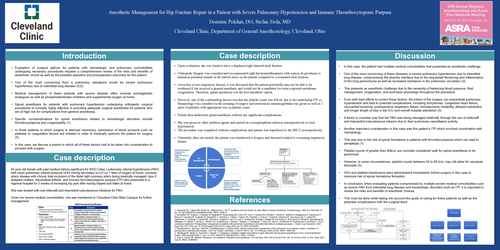
Anesthetic Management for Hip Fracture Repair in a Patient with Severe Pulmonary Hypertension and Immune Thrombocytopenic Purpura
• Evaluation of surgical options for patients with hematologic and pulmonary comorbidities
undergoing necessary procedures requires a comprehensive review of the risks and benefits of
anesthetic choice as well as the possible operative and postoperative outcomes for the patient.
• One of the most concerning from a pulmonary standpoint would be severe pulmonary
hypertension due to interstitial lung disease (ILD).
• Medical management of these patients with severe disease often involves prostaglandin
analogues as well as phosphodiesterase inhibitors and supplemental oxygen at home.
• Spinal anesthesia for patients with pulmonary hypertension undergoing orthopedic surgical
procedures is normally highly effective in providing adequate surgical anesthesia for patients who
are at high risk for complications from general anesthesia.
• Specific contraindications for spinal anesthesia related to hematologic disorders include
thrombocytopenia and coagulopathy (1).
• In those patients in which surgery is deemed necessary, transfusion of blood products such as
platelets or coagulation factors are initiated in order to medically optimize the patient for surgery
(5).
• In this case, we discuss a patient in which all of these factors had to be taken into consideration to
proceed with surgery.
63 year old female with past medical history significant for WHO Class I pulmonary arterial hypertension (PAH)
with mean pulmonary arterial pressure of 63 mmHg secondary to ILD on 7 liters of oxygen at home, coronary
artery disease with chronic total occlusion of the distal right coronary artery being medically managed, type 2
diabetes mellitus, rheumatoid arthritis, and immune thrombocytopenic purpura (ITP) who presented to a
regional hospital for 3 weeks of increasing hip pain after having tripped and fallen at home.
She was treated with oral sildenafil and treprostinil subcutaneous infusions for PAH.
Given her severe medical comorbidities, she was transferred to Cleveland Clinic Main Campus for further
management.
• Upon evaluation, she was found to have a displaced right femoral neck fracture.
• Orthopedic Surgery was consulted and recommended right hip hemiarthroplasty with a press-fit prosthesis to
minimize potential cement or fat emboli stress on the patient compared to a cemented stem fixation.
• Given her severe respiratory disease, it was discussed that the patient potentially may not be able to be
extubated if she received a general anesthetic and would not be a candidate for extra corporeal membrane
oxygenation. Therefore, spinal anesthesia was the best anesthetic option.
• However, one of the confounding factors was that her platelet count was 65k/uL due to her underlying ITP, so
Hematology was consulted on the morning of surgery and intravenous immunoglobulin was given as well as 2
units of platelets with appropriate rise in platelet count.
• Patient then underwent spinal anesthesia without any significant complications.
• She was given no other sedation agents and started on a norepinephrine infusion intraoperatively to treat
hypotension.
• The procedure was completed without complications and patient was transferred to the MICU postoperatively.
• Ultimately after one month, the patient was transferred to hospice and deceased related to worsening respiratory
failure.
• In this case, the patient had multiple medical comorbidities that presented an anesthetic challenge.
• One of the most concerning of these diseases is severe pulmonary hypertension due to interstitial
lung disease, compromising the alveolar interface due to the sequential thickening and inflammation
of the lung parenchyma as well as increased resistance in the pulmonary circulation (2).
• This presents an anesthetic challenge due to the necessity of balancing blood pressure, fluid
management, oxygenation, and acid-base physiology throughout the procedure.
• Even with best efforts to control these factors, the stress of the surgery can exacerbate pulmonary
hypertension and lead to potential complications, including arrhythmias, congestive heart failure,
myocardial ischemia, postoperative respiratory failure, hemodynamic instability, delayed extubation,
and longer length of stay in the ICU and overall hospital admission (3).
• A factor to consider was that her PAH was being managed medically through the use of sildenafil
and treprostinil subcutaneous infusion due to their pulmonary vasodilatory activity.
• Another important consideration in this case was this patient’s ITP which involved coordination with
Hematology.
• This was due to the risk of spinal hematoma in patients with thrombocytopenia which can lead to
paraplegia (1).
• Platelet counts of greater than 80k/uL are normally considered safe for spinal anesthesia to be
performed.
• However, in some circumstances, platelet counts between 50 to 80 k/uL may still allow for neuraxial
blockade (5).
• IVIG and platelet transfusions were administered immediately before surgery in this case to
minimize risk of spinal hematoma formation.
• In conclusion, when evaluating patients compromised by multiple severe medical comorbidities such
as severe PAH from interstitial lung disease and hematologic disorders such as ITP, it is important to
review the risks and benefits of anesthetic choices.
• This must be done while taking into account the goals of caring for these patients as well as the
potential complications with the surgical team.
1. Carpenter RL, Caplan RA, Brown DL, Stephenson C, Wu R. Incidence and risk factors for side effects of spinal anesthesia. Anesthesiology. 1992 Jun;76(6):906-16.
doi: 10.1097/00000542-199206000-00006. PMID: 1599111.
2. McGlothlin DP, Granton J, Klepetko W, Beghetti M, Rosenzweig EB, Corris PA, Horn E, Kanwar MK, McRae K, Roman A, Tedford R, Badagliacca R, Bartolome S,
Benza R, Caccamo M, Cogswell R, Dewachter C, Donahoe L, Fadel E, Farber HW, Feinstein J, Franco V, Frantz R, Gatzoulis M, Hwa Anne Goh C, Guazzi M,
Hansmann G, Hastings S, Heerdt PM, Hemnes A, Herpain A, Hsu CH, Kerr K, Kolaitis NA, Kukreja J, Madani M, McCluskey S, McCulloch M, Moser B, Navaratnam M,
Rådegran G, Reimer C, Savale L, Shlobin OA, Svetlichnaya J, Swetz K, Tashjian J, Thenappan T, Vizza CD, West S, Zuckerman W, Zuckermann A, De Marco T. ISHLT
consensus statement: Perioperative management of patients with pulmonary hypertension and right heart failure undergoing surgery. J Heart Lung Transplant. 2022
Sep;41(9):1135-1194. doi: 10.1016/j.healun.2022.06.013. Epub 2022 Jun 23. PMID: 36123001.
3. Ramakrishna G, Sprung J, Ravi BS, Chandrasekaran K, McGoon MD. Impact of pulmonary hypertension on the outcomes of noncardiac surgery: predictors of
perioperative morbidity and mortality. J Am Coll Cardiol. 2005 May 17;45(10):1691-9. doi: 10.1016/j.jacc.2005.02.055. PMID: 15893189.
4. Yamakage M, Namiki A, Tsuchida H, Iwasaki H. Changes in ventilatory pattern and arterial oxygen saturation during spinal anaesthesia in man. Acta Anaesthesiol
Scand. 1992 Aug;36(6):569-71. doi: 10.1111/j.1399-6576.1992.tb03520.x. PMID: 1514344.
5. Yuan S, Otrock ZK. Platelet Transfusion: An Update on Indications and Guidelines. Clin Lab Med. 2021 Dec;41(4):621-634. doi: 10.1016/j.cll.2021.07.005. Epub 2021
Sep 30. PMID: 34689969.