457 posters, 2 videos, 2 audios, 8 topics, 45 sessions, 401 authors, 265 institutions
ePostersLive by SciGen Technologies S.A. All rights reserved.
49th Annual Regional Anesthesiology and Acute Pain Medicine Meeting
March 21-23, 2024 | The Hilton Bayfront San Diego | San Diego, California

5589
ERECTOR SPINAE PLANE BLOCK AND ITS ANALGESIC CONTRIBUTION FOR POSTERIOR SHOULDER SURGERY
Poster Presenter
Authors
Affiliations
Part of Topic
Medically Challenging Cases
- Shoulder arthroscopy is a minimally invasive surgery usually performed to treat severe rotator cuff injuries.
- Severe postoperative pain due to retention of lavage fluid from continuous pressure washing of the joint cavity and due to surgical trauma, emphasizing the importance of effective pain management for these patients [2].
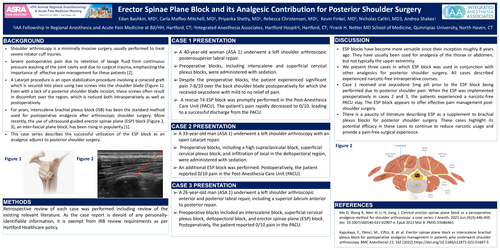
- A Latarjet procedure is an open stabilization procedure involving a coracoid graft which is secured into place using two screws into the shoulder blade (Figure 1). Even with a lack of a posterior shoulder blade incision, these screws often result in discomfort over the region, which is noticed both intraoperatively as well as postoperatively.
- For years, interscalene brachial plexus block (ISB) has been the standard method used for postoperative analgesia after arthroscopic shoulder surgery. More recently, the use of ultrasound guided erector spinae plane (ESP) block (Figure 2, 3), an inter-fascial plane block, has been rising in popularity [1].
- This case series describes the successful utilization of the ESP block as an analgesic adjunct to posterior shoulder surgery.
Retrospective review of each case was performed including review of the existing relevant literature. As the case report is devoid of any personally-identifiable information, it is exempt from IRB review requirements as per Hartford Healthcare policy.
- A 40-year-old woman (ASA 1) underwent a left shoulder arthroscopic posterosuperior labral repair.
- Preoperative blocks, including interscalene and superficial cervical plexus blocks, were administered with sedation.
- Despite the preoperative blocks, the patient experienced significant pain 7-8/10 over the back shoulder blade postoperatively for which she received oxycodone with mild to no relief of pain.
- A rescue T4 ESP block was promptly performed in the Post-Anesthesia Care Unit (PACU). The patient's pain rapidly decreased to 0/10, leading to a successful discharge from the PACU.
- A 33-year-old man (ASA 1) underwent a left shoulder arthroscopy with an open Latarjet repair.
- Preoperative blocks, including a high supraclavicular block, superficial cervical plexus block, and infiltration of local in the deltopectoral region, were administered with sedation.
- An additional ESP block was performed. Postoperatively, the patient reported 0/10 pain in the Post-Anesthesia Care Unit (PACU).
- A 26-year-old man (ASA 1) underwent a left shoulder arthroscopic anterior and posterior labral repair, including a superior labrum anterior to posterior repair.
- Preoperative blocks included an interscalene block, superficial cervical plexus block, deltopectoral block, and erector spinae plane (ESP) block. Postoperatively, the patient reported 0/10 pain in the PACU.
- ESP blocks have become more versatile since their inception roughly 8 years ago. They have usually been used for analgesia of the thorax or abdomen, but not typically the upper extremity.
- We present three cases in which ESP block was used in conjunction with other analgesics for posterior shoulder surgery. All cases described experienced narcotic-free intraoperative courses.
- Case 1 received oral oxycodone 5mg pill prior to the ESP block being performed due to posterior shoulder pain. When the ESP was implemented preoperatively in cases 2 and 3, the patients experienced a narcotic-free PACU stay. The ESP block appears to offer effective pain management post-shoulder surgery.
- There is a paucity of literature describing ESP as a supplement to brachial plexus blocks for posterior shoulder surgery. These cases highlight its potential efficacy in these cases to continue to reduce narcotic usage and provide a pain-free surgical experience.