457 posters, 2 videos, 2 audios, 8 topics, 45 sessions, 401 authors, 265 institutions
ePostersLive by SciGen Technologies S.A. All rights reserved.
49th Annual Regional Anesthesiology and Acute Pain Medicine Meeting
March 21-23, 2024 | The Hilton Bayfront San Diego | San Diego, California

5308
BILATERAL STELLATE GANGLION BLOCK CATHETERS FOR SEVERE REFRACTORY CEREBRAL VASOSPASM FOLLOWING ANEURYSMAL SUBARACHNOID HEMORRHAGE
Poster Presenter
Authors
Part of Topic
Medically Challenging Cases
Introduction
•Cerebral vasospasm (CV) and delayed cerebral ischemia remain a feared complication following aneurysmal subarachnoid hemorrhage (SAH).
•CV is the leading cause of disability and death in these patients, for which prevention is key.
•Multiple therapies exist for the prevention of CV including oral Nimodipine, maintenance of euvolemia, and frequent surveillance.
•Balloon angioplasty, intra-arterial vasodilators, mechanical augmentation with aortic obstruction, and stellate ganglion blocks are for cases refractory standard therapy.
Case Report
•36 year-old female with past medical history of hypertension presenting with SAH due to ruptured posterior communicating artery (PComm) aneurysm.
•The patient underwent extraventricular drain placement, endovascular coiling of ruptured right Pcomm, and was transferred to the neurosurgical intensive care unit (NSICU), where she remained intubated with daily transcranial dopplers (TCDs) surveillance.
•Developed moderate CV of the right middle cerebral artery (MCA) and mild CV in the left MCA and anterior cerebral arteries (ACA) on hospital day 2.
•Despite hemodynamic augmentation, euvolemic maintenance, and intravenous Milrinone, anesthesiology was consulted for refractory CV
•Bilateral stellate ganglion single-shot blocks with 8ml Ropivacaine 0.2% were performed successfully with TCDs showing no evidence of vasospasm the following day. On hospital day 4, the patient developed recurrent refractory CV, for which anesthesiology was re-engaged.
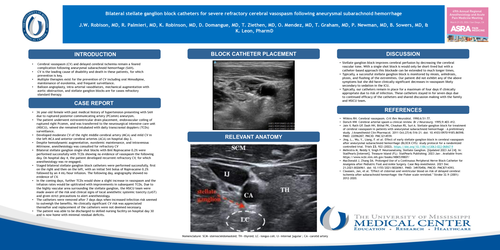
•Staged bilateral stellate ganglion block catheters were performed successfully, first on the right and then on the left, with an initial 5ml bolus of Ropivacaine 0.2% followed by an 4 mL/hour infusion. The following day, angiography showed no evidence of CV.
•In the coming days, further TCDs would show a slight increase in vasospasm and the infusion rates would be uptitrated with improvements in subsequent TCDs. Due to the highly vascular area surrounding the stellate ganglion, the NSICU team were made aware of the risk and clinical signs of local anesthetic systemic toxicity (LAST) and given strict precautions to alert anesthesiology.
•The catheters were removed after 7 days days when increased infection risk seemed to outweigh the benefits. No clinically significant CV risk was appreciated thereafter and replacement of the catheters were not deemed necessary.
•The patient was able to be discharged to skilled nursing facility on hospital day 30 and is now home with minimal residual deficits.
Discussion
•Stellate ganglion block improves cerebral perfusion by decreasing the cerebral vascular tone. With a single shot block is would only be short-lived but with a catheter-based approach this blockade can be extended to much longer times.
•Typically, a successful stellate ganglion block is monitored by miosis, anhidrosis, ptosis, and flushing of the extremities. Our patient did not exhibit any of the above symptoms but she did have clinically significant decreases in vasospasm likely secondary to sedation in the ICU.
•Typically, our catheters remain in place for a maximum of four days if clinically appropriate due to risk of infection. These catheters stayed in for seven days due to continued efficacy of the catheters and shared discussion making with the family and NSICU team.
Referances
•Wilkins RH. Cerebral vasospasm. Crit Rev Neurobiol. 1990;6:51–77.
•Dorsch NW. Cerebral arterial spasm a clinical review. Br J Neurosurg. 1995;9:403–412.
•Jain V, Rath GP, Dash HH, Bithal PK, Chouhan RS, Suri A. Stellate ganglion block for treatment of cerebral vasospasm in patients with aneurysmal subarachnoid hemorrhage - A preliminary study. J Anaesthesiol Clin Pharmacol. 2011 Oct;27(4):516-21. doi: 10.4103/0970-9185.86598. PMID: 22096287; PMCID: PMC3214559.
•Jing, L., Wu, Y., Liang, F. et al. Effect of early stellate ganglion block in cerebral vasospasm after aneurysmal subarachnoid hemorrhage (BLOCK-CVS): study protocol for a randomized controlled trial. Trials 23, 922 (2022). https://doi.org/10.1186/s13063-022-06867-9
•Mehrotra M, Reddy V, Singh P. Neuroanatomy, Stellate Ganglion. [Updated 2023 Jul 24]. In: StatPearls [Internet]. Treasure Island (FL): StatPearls Publishing; 2023 Jan-. Available from: https://www.ncbi.nlm.nih.gov/books/NBK539807/
•MacDonald J, Zhang DA. Prolonged Use of a Continuous Peripheral Nerve Block Catheter for Analgesia after Pediatric Foot and Ankle Surgery. Case Rep Anesthesiol. 2021 Dec 21;2021:8026961. doi: 10.1155/2021/8026961. PMID: 34970456; PMCID: PMC8714393.
•Claassen, Jan, et al. "Effect of cisternal and ventricular blood on risk of delayed cerebral ischemia after subarachnoid hemorrhage: the Fisher scale revisited." Stroke 32.9 (2001): 2012-2020.