457 posters, 2 videos, 2 audios, 8 topics, 45 sessions, 401 authors, 265 institutions
ePostersLive by SciGen Technologies S.A. All rights reserved.
49th Annual Regional Anesthesiology and Acute Pain Medicine Meeting
March 21-23, 2024 | The Hilton Bayfront San Diego | San Diego, California

5221
PREVIOUSLY UNREPORTED COMPLICATIONS ASSOCIATED WITH PEDIATRIC SUPRAZYGOMATIC MAXILLARY NERVE (SZMN) BLOCKS: A CASE REPORT
Poster Presenter
Authors
Affiliations
Part of Topic
Medically Challenging Cases
Previously Unreported Complications Associated with Pediatric Suprazygomatic Maxillary Nerve (SZMN) Blocks: A Case Report
Introduction
Suprazygomatic maxillary nerve (SZMN) blocks are commonly used for analgesia following cleft palate repair (1), and recently have been applied to adenotonsillectomies (T&A) (2) and Le Fort I osteotomies (3). The suprazygomatic approach to the maxillary nerve block is regarded as the safest and most reliable approach (4). The SZMN block targets the maxillary division of the trigeminal nerve as it passes through the pterygopalatine fossa (PPF). The maxillary nerve provides sensory innervation to the anterior and posterior palate, upper dental arch, maxillary sinus, and posterior nasal cavity (3). The SZMN block is performed by inserting a needle at the frontozygomatic angle formed by the posterior orbital rim and zygomatic arch. The needle is then directed in a caudal and posterior medial direction into the infratemporal fossa towards the PPF until the needle encounters osseous resistance. Known complications of maxillary nerve blockade include hematoma (5) and untoward local anesthetic spread to surrounding structures and nerves (1); however, these are mostly described with infrazygomatic approaches and only in adult patients. We describe three previously unreported complications following SZMN blockade in three pediatric patients.
Materials and Methods
Data for nerve block complications were collected through post-operative surveillance at one pediatric academic hospital. In our practice, we routinely assess for efficacy and complications in patients receiving nerve blocks through follow-up phone calls and/or inpatient assessments.
As the case report is devoid of patient identifiable information, it is exempt from IRB review requirements as per Stanford University policy. Informed written consent was obtained from the legal guardian of all patients included in the following case report.
Case 1
A 7-year-old, 27kg, male (ASA 2) with obstructive sleep apnea (OSA) underwent intracapsular palatine tonsillectomy and adenoidectomy (T&A). Bilateral single injection SZMN blocks were performed with 5 mL of 0.5% ropivacaine per side following endotracheal intubation. General anesthesia was maintained with a propofol infusion and sevoflurane. Other medications included hydromorphone, acetaminophen, dexamethasone, and ondansetron. In the post-anesthesia care unit (PACU), he reported diplopia with strabismus. Upon exam, his disconjugate gaze was consistent with a left abducens nerve palsy, which subsequently resolved within 12 hours as the SZMN block resolved.
Case 2
A 5-year-old, 18kg female (ASA 2) with recurrent pharyngitis and grade 4 tonsillar hypertrophy underwent total T&A. She received bilateral SZMN blocks with 5 mL of 0.2% ropivacaine and 5 micrograms of dexmedetomidine per side following endotracheal intubation. General anesthesia was maintained with sevoflurane and propofol infusion. Other medications received included acetaminophen, dexamethasone, dexmedetomidine, ondansetron and a scopolamine patch. In the PACU, she had a right eyelid droop consistent with levator palpebrae superioris palsy, concerning for a partial oculomotor nerve blockade that resolved within 24 hours.
Case 3
A 5-year-old, 28kg male (ASA 3) with severe OSA underwent intracapsular T&A. He received bilateral SZMN blocks with 5 mL of 0.5% ropivacaine per side following endotracheal intubation. General anesthesia was maintained with sevoflurane anesthesia. Other medications received included hydromorphone, acetaminophen, dexamethasone, dexmedetomidine, and ondansetron. Upon awakening, he was noted to have a dilated right pupil consistent with a right oculomotor nerve palsy, which resolved within 5 hours.
Discussion
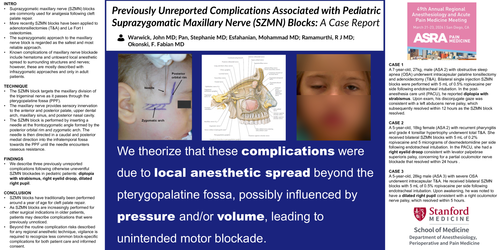
We describe three previously unreported complications following otherwise uneventful SZMN blockades in pediatric patients. Despite appropriate needling technique, these complications were likely due to local anesthetic spread beyond the PPF, possibly influenced by injection pressure and/or total volume. The proposed mechanism of local anesthetic spread is based on the anatomic proximity of additional neurovascular structures. Specifically, the PPF is bordered superiorly by the inferior orbital fissure (IOF), which is situated on the orbital floor in close proximity to the superior orbital fissure (SOF). Cranial nerve III (oculomotor) and cranial nerve VI (abducens) travel through the SOF to reach their innervation sites. We theorize that our patients had unintended spread of local anesthesia through the IOF leading to unintended motor blockade.
Conclusion
SZMN blocks have traditionally been performed around a year of age for cleft palate repair. As SZMN blocks are increasingly performed for other surgical indications in older patients, patients may describe complications that were previously unnoticed. Beyond the routine complication risks described for any regional anesthetic technique, vigilance is required to recognize less common block-specific complications for both patient care and informed consent.
References
- Chiono, J., Raux, O., Bringuier, S., Sola, C., Bigorre, M., Capdevila, X., & Dadure, C. (2014). Bilateral Suprazygomatic Maxillary Nerve Block for Cleft Palate Repair in Children: A Prospective, Randomized, Double-blind Study versus Placebo. Anesthesiology, 120(6), 1362–1369. https://doi.org/10.1097/ALN.0000000000000171
- Smith, L., Balakrishnan, K., Pan, S., & Tsui, B. C. H. (2021). Suprazygomatic maxillary (SZM) nerve blocks for perioperative pain control in pediatric tonsillectomy and adenoidectomy. Journal of Clinical Anesthesia, 71, 110240. https://doi.org/10.1016/j.jclinane.2021.110240
- Nores, G. D. G., Cuzzone, D. A., Hush, S. E., Pandya, K., Stuart, A., Williams, J. K., & Brady, C. M. (2020). The Impact of Bilateral Suprazygomatic Maxillary Nerve Blocks on Postoperative Pain Control in Patients Undergoing Orthognathic Surgery. FACE, 1(1), 58–65. https://doi.org/10.1177/2732501620949188
- Jerman, A., Umek, N., Cvetko, E., & Snoj, Ž. (2023). Comparison of the feasibility and safety of infrazygomatic and suprazygomatic approaches to pterygopalatine fossa using virtual reality. Regional Anesthesia and Pain Medicine, 48(7), 359–364. https://doi.org/10.1136/rapm-2022-104068
- Stajčič Z, Todorović Lj. Blocks of the foramen rotundum and the oval foramen: a reappraisal of extraoral maxillary and mandibular nerve injections. British Journal of Oral and Maxillofacial Surgery. 1997 Oct;35(5):328–33. https://doi.org/10.1016/S0266-4356(97)90405-8