Loading...

457 posters, 2 videos, 2 audios, 8 topics, 45 sessions, 401 authors, 265 institutions

ePostersLive by SciGen Technologies S.A. All rights reserved.

49th Annual Regional Anesthesiology and Acute Pain Medicine Meeting

March 21-23, 2024 | The Hilton Bayfront San Diego | San Diego, California

49th Annual Regional Anesthesiology and Acute Pain Medicine Meeting banner

5362

NEONATAL INTESTINAL SURGERY: A CASE OF UTILIZING THE QUADRATUS LUMBORUM BLOCK FOR ERAS
Part of Topic

Medically Challenging Cases

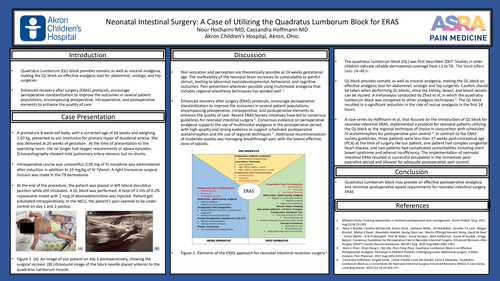
•A premature 8-week-old baby, with a corrected age of 34 weeks and weighing 2.07 kg, presented to our institution for primary repair of duodenal atresia. She was delivered at 26 weeks of gestation . At the time of presentation to the operating room, she no longer had oxygen requirements or apnea episodes. Echocardiography showed mild pulmonary artery stenosis but no shunts. 
•
•Intraoperative course was uneventful; 0.05 mg of IV morphine was administered after induction in addition to 10 mg/kg of IV Tylenol. A right transverse surgical incision was made in the T9 dermatome.
•
•At the end of the procedure, the patient was placed in left lateral decubitus position while still intubated. A QL block was performed. A total of 2 mls of 0.2% ropivacaine mixed with 2 mcg of dexmedetomidine was injected. Patient got extubated intraoperatively. In the NICU, the patient’s pain seemed to be under control on day 1 and 2 postop.
•Pain sensation and perception are theoretically possible at 24 weeks gestational age. The malleability of the neonatal brain increases its vulnerability to painful stimuli, leading to abnormal neurodevelopmental, behavioral, and cognitive outcomes. Pain prevention whenever possible using multimodal analgesia that includes regional anesthesia techniques has worked well 1.
•Enhanced recovery after surgery (ERAS) protocols, encourage perioperative standardization to improve the outcomes in several patient populations, encompassing preoperative, intraoperative, and postoperative elements to enhance the quality of care. Recent ERAS Society initiatives have led to consensus guidelines for neonatal intestinal surgery 2. Consensus evidence on perioperative analgesia supports the use of multimodal analgesia in the postoperative period, with high-quality and strong evidence to support scheduled postoperative acetaminophen and the use of regional techniques 2. Additional recommendation of moderate quality was managing breakthrough pain with the lowest effective dose of opioids.

The quadratus lumborum block (QL) was first described 2007. Studies in older children indicate reliable dermatomal coverage from L1 to T8 . The block effect lasts 24–48 h.

QL block provides somatic as well as visceral analgesia, making the QL block an effective analgesic tool for abdominal, urologic and hip surgeries. Caution should be taken when performing QL blocks, since the kidney, bowel, and blood vessels can be injured. A metanalysis conducted by Zhao et al, in which the quadratus lumborum block was compared to other analgesic techniques 3. The QL block resulted in a significant reduction in the rate of rescue analgesia in the first 24 hours. 

A case series by Hoffmann et al, that focused on the introduction of QL block for neonatal intestinal ERAS, implemented a protocol for neonatal patients utilizing the QL block as the regional technique of choice in conjunction with scheduled IV acetaminophen for postoperative pain control 4. In contrast to the ERAS society guidelines, three patients were less than 37 weeks post-conceptual age (PCA) at the time of surgery like our patient, one patient had complex congenital heart disease, and two patients had complicated comorbidities including short bowel syndrome and adrenal insufficiency. The implementation of neonatal intestinal ERAS resulted in successful extubation in the immediate post-operative period and allowed for adequate postoperative pain control. 

49th Annual Regional Anesthesiology and Acute Pain Medicine Meeting » banner
Copyright © 2015-2026, ePostersLive® SciGen is a registered trademark of SciGen Technologies S.A. Patent pending.

This website and third-party tools we use rely on cookies for the best user experience. By selecting "I agree", you agree to cookie usage as described in our Privacy Policy.