457 posters, 2 videos, 2 audios, 8 topics, 45 sessions, 401 authors, 265 institutions
ePostersLive by SciGen Technologies S.A. All rights reserved.
49th Annual Regional Anesthesiology and Acute Pain Medicine Meeting
March 21-23, 2024 | The Hilton Bayfront San Diego | San Diego, California

5619
EXTERNAL OBLIQUE INTERCOSTAL BLOCK: AN ALTERNATIVE TECHNIQUE FOR REGIONAL ANESTHESIA IN ONCOLOGIC ABDOMINAL SURGERY
Poster Presenter
Part of Topic
Medically Challenging Cases
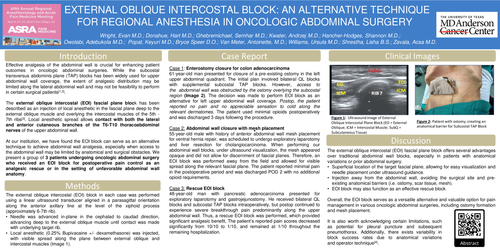
Wright, Evan M.D.; Donahue, Hart M.D.; Ghebremichael, Semhar M.D.; Kwater, Andrzej M.D.; Hancher-Hodges, Shannon M.D.; Owolabi, Adebukola M.D.; Popat, Keyuri M.D.; Bryce Speer D.O.; Van Meter, Antoinette, M.D.; Williams, Ursula M.D.; Shrestha, Lisha B.S.; Zavala, Acsa M.D. Effective analgesia of the abdominal wall is crucial for enhancing patient outcomes in oncologic abdominal surgeries. While the subcostal transversus abdominis plane (TAP) blocks has been widely used for upper abdominal wall coverage, the extent of analgesic distribution may be limited along the lateral abdominal wall and may not be feasibility to perform in certain surgical patients[1,2] . The external oblique intercostal (EOI) fascial plane block has been described as an injection of local anesthetic in the fascial plane deep to the external oblique muscle and overlying the intercostal muscles of the 5th - 7th ribs[3] . Local anesthetic spread allows contact with both the lateral and anterior cutaneous branches of the T6-T10 thoracoabdominal nerves of the upper abdominal wall. At our institution, we have found the EOI block can serve as an alternative technique to achieve abdominal wall analgesia, especially when access to the abdominal wall may be limited by anatomical and surgical obstacles. We present a group of 3 patients undergoing oncologic abdominal surgery who received an EOI block for postoperative pain control as an analgesic rescue or in the setting of unfavorable abdominal wall anatomy. Case 1: Enterostomy closure for colon adenocarcinoma 61-year-old man presented for closure of a pre-existing ostomy in the left upper abdominal quadrant. The initial plan involved bilateral QL blocks with supplemental subcostal TAP blocks. However, access to the abdominal wall was obstructed by the ostomy overlying the subcostal region (Image 2). The decision was made to perform EOI block as an alternative for left upper abdominal wall coverage. Postop, the patient reported no pain and no appreciable sensation to cold along the relevant dermatomes. The patient used minimal opioids postoperatively and was discharged 3 days following the procedure. Case 2: Abdominal wall closure with mesh placement 55-year-old male with history of anterior abdominal wall mesh placement for ventral hernia repair, was scheduled to undergo exploratory laparotomy and liver resection for cholangiocarcinoma. When performing our abdominal wall blocks, under ultrasound visualization, the mesh appeared opaque and did not allow for discernment of fascial planes. Therefore, an EOI block was performed away from the field and allowed for visible spread along the relevant fascial plane. The patient reported minimal pain in the postoperative period and was discharged POD 2 with no additional opioid requirements. Case 3: Rescue EOI block 48-year-old man with pancreatic adenocarcinoma presented for exploratory laparotomy and gastrojejunostomy. He received bilateral QL blocks and subcostal TAP blocks intraoperatively, but postop continued to experience severe breakthrough pain predominantly along the upper abdominal wall. Thus, a rescue EOI block was performed, which provided significant analgesic benefit, The patient’s reported pain scores decreased significantly from 10/10 to 1/10, and remained at 1/10 throughout the remaining hospitalization. EXTERNAL OBLIQUE INTERCOSTAL BLOCK: AN ALTERNATIVE TECHNIQUE FOR REGIONAL ANESTHESIA IN ONCOLOGIC ABDOMINAL SURGERY Figure 1: Ultrasound image of External Oblique Intercostal Plane Block (EO = External Oblique; ICM = Intercostal Muscle; SubQ = Subcutaneous Tissue) Discussion Case Report Methods Introduction The external oblique intercostal (EOI) block in each case was performed using a linear ultrasound transducer aligned in a parasagittal orientation along the anterior axillary line at the level of the xiphoid process (approximately 6-7th rib). • Needle was advanced in-plane in the cephalad to caudad direction, advancing deep to the external oblique muscle until contact was made with underlying target rib. • Local anesthetic (0.25% Bupivacaine +/- dexamethasone) was injected, with visible spread along the plane between external oblique and intercostal muscles (Image 1). Clinical Images Figure 2: Patient with ostomy, creating an anatomical barrier for Subcostal TAP Block • The external oblique intercostal (EOI) fascial plane block offers several advantages over traditional abdominal wall blocks, especially in patients with anatomical variations or prior abdominal surgery. • Superficial location of the target fascial plane, allowing for easy visualization and needle placement under ultrasound guidance. • Injection away from the abdominal wall, avoiding the surgical site and preexisting anatomical barriers (i.e. ostomy, scar tissue, mesh). • EOI block may also function as an effective rescue block Overall, the EOI block serves as a versatile alternative and valuable option for pain management in various oncologic abdominal surgeries, including ostomy formation and mesh placement. It is also worth acknowledging certain limitations, such as potential for pleural puncture and subsequent pneumothorax. Additionally, there exists variability in block success rates due to anatomical variations and operator technique [4] .