457 posters, 2 videos, 2 audios, 8 topics, 45 sessions, 401 authors, 265 institutions
ePostersLive by SciGen Technologies S.A. All rights reserved.
49th Annual Regional Anesthesiology and Acute Pain Medicine Meeting
March 21-23, 2024 | The Hilton Bayfront San Diego | San Diego, California

5571
ACUTE BRONCHOSPASM FOLLOWING INTERSCALENE NERVE BLOCK
Poster Presenter
Authors
Affiliations
Part of Topic
Medically Challenging Cases
Acute Bronchospasm After Interscalene Brachial Plexus Nerve Block
In anesthesia, preparation is key as predictability is not an expectation. Prior to undergoing a rotator cuff repair, an interscalene nerve block can help reduce both peri-op and post-op pain that minimizes sedation requirements throughout the procedure in order to maintain stable vital signs and decreases opiate requirements both peri-op and post-op. Acute bronchospasm is an uncommon complication that has been reported more than thirty years ago1.
A 60 yo male with past medical history of childhood seizure and controlled asthma presented for right rotator cuff surgery. Labs were unremarkable and EKG showed NSR. Patient’s physical exam was also unremarkable. An interscalene nerve block was successfully performed prior to intubation. 10 ml of 0.5% Bupivacaine was injected with ultrasound-guidance. Upon completion of the nerve block preoperatively, the patient developed significant dyspnea, tachycardia, hypertension, and mild bilateral wheezing. After administration of O2 mask with 10 LPM O2 and albuterol, the patient’s SpO2 showed 100%, but he still complained of significant trouble breathing. Subsequent CXR was unremarkable and the case was postponed with the patient being discharged after a few hours.
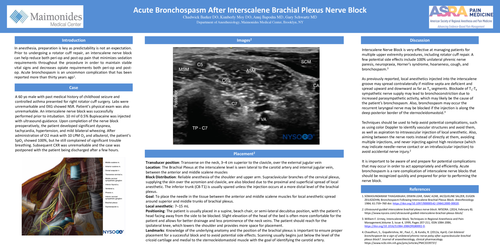
Transducer position: Transverse on the neck, 3–4 cm superior to the clavicle, over the external jugular vein
Location: The Brachial Plexus at the interscalene level is seen lateral to the carotid artery and internal jugular vein, between the anterior and middle scalene muscles
Block Distribution: Reliable anesthesia of the shoulder and upper arm. Supraclavicular branches of the cervical plexus, supplying the skin over the acromion and clavicle, are also blocked due to the proximal and superficial spread of local anesthetic. The inferior trunk (C8-T1) is usually spared unless the injection occurs at a more distal level of the brachial plexus.
Goal: To place the needle in the tissue between the anterior and middle scalene muscles for local anesthetic spread around superior and middle trunks of brachial plexus.
Local anesthetic: 7–15 mL
Positioning: The patient is usually placed in a supine, beach chair, or semi-lateral decubitus position, with the patient’s head facing away from the side to be blocked. Slight elevation of the head of the bed is often more comfortable for the patient and allows for better drainage and less prominence of the neck veins. The patient should reach for the ipsilateral knee, which lowers the shoulder and provides more space for placement.
Landmarks: Knowledge of the underlying anatomy and the position of the brachial plexus is important to ensure proper placement for a successful block and to avoid potential side effects. Scanning usually begins just below the level of the cricoid cartilage and medial to the sternocleidomastoid muscle with the goal of identifying the carotid artery.
Interscalene Nerve Block is very effective at managing patients for multiple upper extremity procedures, including rotator cuff repair. A few potential side effects include 100% unilateral phrenic nerve paresis, neuropraxia, Horner's syndrome, hoarseness, cough, and bronchospasm.3
As previously reported, local anesthetics injected into the interscalene groove may spread contralaterally if midline septa are deficient and spread upward and downward as far as T4 segments. Blockade of T1-T4 sympathetic nerve supply may lead to bronchoconstriction due to increased parasympathetic activity, which may likely be the cause of the patient’s bronchospasm. Also, bronchospasm may occur the recurrent laryngeal nerve may be blocked if the injection is along the deep posterior border of the sternocleidomastoid.4
Techniques should be used to help avoid potential complications, such as using color Doppler to identify vascular structures and avoid them, as well as aspiration to intravascular injection of local anesthetic. Also, aiming between the nerve roots instead of directly at them, avoiding multiple injections, and never injecting against high resistance (which may indicate needle–nerve contact or an intrafascicular injection) to avoid accidental nerve injury.2
It is important to be aware of and prepare for potential complications that may occur in order to act appropriately and efficiently. Acute bronchospasm is a rare complication of interscalene nerve blocks that should be recognized quickly and prepared for prior to performing the nerve block.