457 posters, 2 videos, 2 audios, 8 topics, 45 sessions, 401 authors, 265 institutions
ePostersLive by SciGen Technologies S.A. All rights reserved.
49th Annual Regional Anesthesiology and Acute Pain Medicine Meeting
March 21-23, 2024 | The Hilton Bayfront San Diego | San Diego, California

5096
MANAGEMENT OF A SUSPECTED INTRAVASCULAR EPIDURAL CATHETER
Poster Presenter
Authors
Affiliations
Part of Topic
Medically Challenging Cases
Management of a Suspected Intravascular Epidural Catheter - Justin Tai, MD | Abdul-Haseeb Sheikh, MD
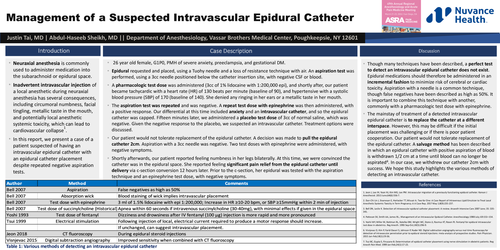
Neuraxial anesthesia is commonly used to administer medication into the subarachnoid or epidural space. Inadvertent intravascular injection of a local anesthetic during neuraxial anesthesia has several consequences, including circumoral numbness, facial tingling, metallic taste in the mouth, and potentially local anesthetic systemic toxicity, which can lead to cardiovascular collapse. In this report, we present a case of a patient suspected of having an intravascular epidural catheter with an epidural catheter placement despite repeated negative aspiration tests.
26 year old female, G1P0, PMH of severe anxiety, preeclampsia, and gestational DM. Epidural requested and placed, using a Tuohy needle and a loss of resistance technique with air. An aspiration test was performed, using a 3cc needle positioned below the catheter insertion site, with negative CSF or blood. A pharmacologic test dose was administered (3cc of 1% lidocaine with 1:200,000 epi), and shortly after, our patient became tachycardic with a heart rate (HR) of 130 beats per minute (baseline of 90), and hypertensive with a systolic blood pressure (SBP) of 170 (baseline of 140). She denied any ringing in her ears or a metallic taste in her mouth. The aspiration test was repeated and was negative. A repeat test dose with epinephrine was then administered, with a positive response. Our differential at this time included anxiety and an intravascular catheter, and so the epidural catheter was capped. Fifteen minutes later, we administered a placebo test dose of 3cc of normal saline, which was negative. Given the negative response to the placebo, we suspected an intravascular catheter. Treatment options were discussed. Our patient would not tolerate replacement of the epidural catheter. A decision was made to pull the epidural catheter 2cm. Aspiration with a 3cc needle was negative. Two test doses with epinephrine were administered, with negative symptoms. Shortly afterwards, our patient reported feeling numbness in her legs bilaterally. At this time, we were convinced the catheter was in the epidural space. She reported feeling significant pain relief from the epidural catheter until delivery via c-section conversion 12 hours later. Prior to the c-section, her epidural was tested with the aspiration technique and an epinephrine test dose, with negative symptoms.
Though many techniques have been described, a perfect test to detect an intravascular epidural catheter does not exist. Epidural medications should therefore be administered in an incremental fashion to minimize risk of cerebral or cardiac toxicity. Aspiration with a needle is a common technique, though false negatives have been described as high as 50%. It is important to combine this technique with another, commonly with a pharmacologic test dose with epinephrine. The mainstay of treatment of a detected intravascular epidural catheter is to replace the catheter at a different interspace. However, this may be difficult if the initial placement was challenging or if there is poor patient cooperation. Our patient would not tolerate replacement of the epidural catheter. A salvage method has been described in which an epidural catheter with positive aspiration of blood is withdrawn 1/2 cm at a time until blood can no longer be aspirated. In our case, we withdrew our catheter 2cm with success. We hope this study highlights the various methods of detecting an intravascular catheter.