457 posters, 2 videos, 2 audios, 8 topics, 45 sessions, 401 authors, 265 institutions
ePostersLive by SciGen Technologies S.A. All rights reserved.
49th Annual Regional Anesthesiology and Acute Pain Medicine Meeting
March 21-23, 2024 | The Hilton Bayfront San Diego | San Diego, California

5290
ESCAPING THE PDPH DILEMMA WITH SPHENOPALATINE MAGIC
Poster Presenter
Authors
Affiliations
Part of Topic
Medically Challenging Cases
Escaping the PDPH Dilemma with Sphenopalatine Magic
Introduction:
•Post-dural puncture headaches (PDPH) are common after epidural/spinal placement or lumbar puncture, with an incidence of 1-8%, depending on provider experience .
•PDPH results from CSF leakage due to dural puncture, leading to theories: (1) loss of CSF leading to decreased pressure leading to compensatory increased cerebral blood flow, or (2) decreased CSF pressure leading to increased mobility of brain structures causing headache.
•Risk factors: younger age, female sex, larger needle, and non-pregnant status.
•Symptoms include headache within 1-2 days, worsened by standing and relieved by lying flat, abdominal binders and caffeine intake, often with neck stiffness.
•Conservative management involves caffeine, acetaminophen, IV fluids, placing an abdominal binder, and lying flat; epidural blood patch (EBP) is definitive but carries risks.
•EBP risks: infection, nerve injury, increased ICP, back pain, and failed symptom relief.
•Contraindications to EBP include but are not limited to : bacteremia, coagulopathy, increased intracranial pressure, and patient refusal
•Sphenopalatine ganglion block, targeting the trigeminal nerve, is a minimally invasive alternative with potential benefits for PDPH treatment [1,2].
Case Description:
•25 y/o F with past medical history of asthma presents with acute bacteremia of unknown source
•Lumbar puncture performed using 22 gauge needle (quincke) at outside hospital (OSH) for meningitis ruled out; pyelonephritis detected on CT scan.
•Developed severe headache post-lumbar puncture, diagnosed w/ PDPH.
•Minimal improvement with acetaminophen-butalbital-caffeine, abdominal binder, and IV fluids.
•Pain management consulted; unable to EBP due to bacteremia.
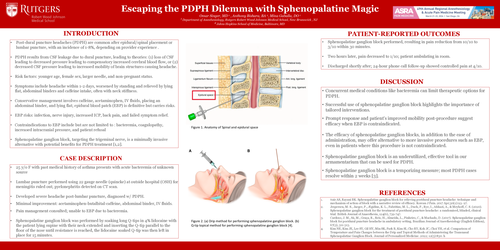
•Sphenopalatine ganglion block was performed by soaking long Q-tips in 4% lidocaine with the patient lying supine with their neck extended and inserting the Q-tip parallel to the floor of the nose until resistance is reached, the lidocaine soaked Q-tip was then left in place for 15 minutes.
Patient Reported Outcomes:
•Sphenopalatine ganglion block performed, resulting in pain reduction from 10/10 to 3/10 within 30 minutes.
•Two hours later, pain decreased to 1/10; patient ambulating in room.
•Discharged shortly after; 24-hour phone call follow-up showed controlled pain at 4/10.
Discussion:
•Concurrent medical conditions like bacteremia can limit therapeutic options for PDPH.
•Successful use of sphenopalatine ganglion block highlights the importance of tailored interventions.
•Prompt response and patient's improved mobility post-procedure suggest efficacy when EBP is contraindicated.
•The efficacy of sphenopalatine ganglion blocks, in addition to the ease of administration, may offer an alternative to more invasive procedures such as EBP, even in patients where this procedure is not contraindicated.
•Sphenopalatine ganglion block is an underutilized, effective tool in our armamentarium that can be used for PDPH.
•Sphenopalatine ganglion block is a temporizing measure; most PDPH cases resolve within 2 weeks [3].