457 posters, 2 videos, 2 audios, 8 topics, 45 sessions, 401 authors, 265 institutions
ePostersLive by SciGen Technologies S.A. All rights reserved.
49th Annual Regional Anesthesiology and Acute Pain Medicine Meeting
March 21-23, 2024 | The Hilton Bayfront San Diego | San Diego, California

5134
PERIOPERATIVE MONITORING OF ICP USING OCULAR ULTRASOUND IN A PATIENT WITH IDIOPATHIC INTRACRANIAL HYPERTENSION
Poster Presenter
Authors
Affiliations
Part of Topic
Medically Challenging Cases
Perioperative Monitoring of ICP Using Ocular Ultrasound in a Patient with Idiopathic Intracranial Hypertension
Austin Bell MD1,2, Ryan Pomicter MD3
1. Dwight D. Eisenhower Army Medical Center
2. Uniformed Services University, Department of Anesthesiology
3. Walter Reed National Military Medical Center
Introduction:
Perioperative monitoring of intracranial pressure (ICP) typically involves the use of invasive monitoring that can be difficult to establish, carries higher bleeding and infection risks, and requires higher levels of nursing care. However, emergency medicine physicians have been utilizing point of care ultrasound as a noninvasive but accurate evaluation for diagnosing intracranial hypertension when invasive modalities are not available, practical, or indicated (1,2). Measurement of the optic nerve sheath diameter has been validated as an indirect assessment of ICP with magnetic resonance imaging, computed tomography scans, and sonography. Perioperatively, positioning in steep Trendelenburg and surgical techniques (laparoscopic and robotic) have been implicated in increases in intracranial pressure which could have serious clinical implications for patients at high risk for elevated ICP (3,4). As point of care ultrasound continues to rise in popularity within the anesthesia community, perioperative sonographic measurement of ONSD can be an effective method to noninvasively monitor changes to ICP (5).
Case Report:
A 48 year old woman, BMI 26, was scheduled for a laparoscopic hysterectomy with bilateral salpingectomy for symptomatic uterine adenomyosis. Her medical history was notable for symptomatic idiopathic intracranial hypertension which initially presented as unilateral pulsatile tinnitus and frequent headache. A lumbar puncture 4 months prior to the surgery resulted in an opening pressure of 36cmH20 for which the patient was treated with acetazolamide and topiramate. On the day of surgery, the patient had no clinical symptoms of increased ICP but a lumbar puncture was performed with an opening pressure of 18.5cmH20 and 13.5ml of cerebrospinal fluid was removed to achieve a closing pressure of 8cmH20.
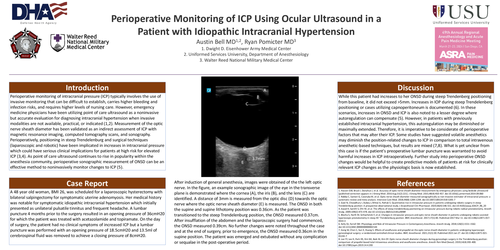
After induction of general anesthesia, images were obtained of the the left optic nerve. In the figure, an example sonographic image of the eye in the transverse plane is demonstrated where the cornea (A), the iris (B), and the lens (C) are identified. A distance of 3mm is measured from the optic disc (D) towards the optic nerve where the optic nerve sheath diameter (E) is measured. The ONSD in both the supine and supine lithotomy position was 0.36cm. As the patient was transitioned to the steep Trendelenburg position, the ONSD measured 0.37cm. After insufflation of the abdomen and the laparoscopic surgery had commenced, the ONSD measured 0.39cm. No further changes were noted throughout the case and at the end of surgery, prior to emergence, the ONSD measured 0.36cm in the supine position. The patient was emerged and extubated without any complication or sequalae in the post-operative period.
Discussion:
While this patient had increases to her ONSD during steep Trendenberg positioning from baseline, it did not exceed >5mm. Increases in IOP during steep Trendelenberg positioning or cases utilizing capnoperitoneum is documented (6). In these scenarios, increases in ONSD and ICP is also noted to a lesser degree where autoregulation can compensate (5). However, in patients with previously established intracranial hypertension, this autoregulation may be diminished or maximally extended. Therefore, it is imperative to be considerate of perioperative factors that may alter their ICP. Some studies have suggested volatile anesthetics may diminish the position-related changes to ICP in comparison to total intravenous anesthetic-based techniques, but results are mixed (7,8). What is yet unclear from this case is if the patient's preoperative lumbar puncture was warranted to avoid harmful increases in ICP intraoperatively. Further study into perioperative ONSD changes would be helpful to create predictive models of patients at risk for clinically relevant ICP changes as the physiologic basis is now established.