457 posters, 2 videos, 2 audios, 8 topics, 45 sessions, 401 authors, 265 institutions
ePostersLive by SciGen Technologies S.A. All rights reserved.
49th Annual Regional Anesthesiology and Acute Pain Medicine Meeting
March 21-23, 2024 | The Hilton Bayfront San Diego | San Diego, California

5317
A NOVEL USE OF AN INFRACLAVICULAR BRACHIAL PLEXUS CATHETER FOR BOTH LIMB AKINESIA AND ANALGESIA IN AGITATED DELIRIUM IN THE ICU
Poster Presenter
Authors
Affiliations
Part of Topic
Medically Challenging Cases
Title: A novel use of an infraclavicular brachial plexus catheter for both limb akinesia and analgesia in agitated delirium in the ICU
PRESENTER: C. Taylor Smith, MD
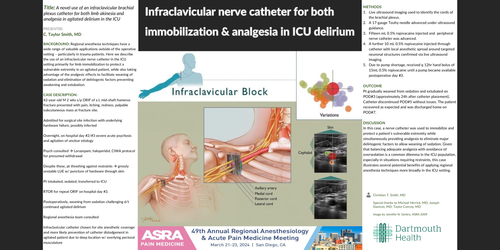
BACKGROUND: Regional anesthesia techniques have a wide range of valuable applications outside of the operative setting – particularly in trauma patients. Here we describe the use of an infraclavicular nerve catheter in the ICU setting primarily for limb immobilization to protect a vulnerable extremity in an agitated patient, while also taking advantage of the analgesic effects to facilitate weaning of sedation and elimination of deliriogenic factors preventing awakening and extubation.
CASE DESCRIPTION:
42-year-old M 2 wks s/p ORIF of a L mid-shaft humerus fracture presented with pain, itching, redness, palpable subcutaneous mass at fracture site.
Admitted for surgical site infection with underlying hardware failure, possibly infected
Overnight, on hospital day #2/#3 severe acute psychosis and agitation of unclear etiology
Psych consulted, ordered Lorazepam, haloperidol, CIWA protocol for presumed withdrawal
Despite these, pt thrashing against restraints led to grossly unstable LUE w/ puncture of hardware through skin
Pt intubated, sedated, transferred to ICU
RTOR for repeat ORIF on hospital day #3.
Postoperatively, weaning from sedation challenging d/t continued agitated delirium
Regional anesthesia team consulted
Infraclavicular catheter chosen for site anesthetic coverage and more likely prevention of catheter dislodgement in agitated patient due to deep location w/ overlying pectoral musculature
METHODS
OUTCOME
Pt gradually weaned from sedation and extubated on POD#3 (approximately 24h after catheter placement). Catheter discontinued POD#5 without issues. The patient recovered as expected and was discharged home on POD#7.
DISCUSSION
In this case, a nerve catheter was used to immobilize and protect a patient’s vulnerable extremity while simultaneously providing analgesia to eliminate major deliriogenic factors to allow weaning of sedation. Given that balancing adequate analgesia with avoidance of oversedation is a common dilemma in the ICU population, especially in situations requiring restraints, this case illustrates several potential benefits of applying regional anesthesia techniques more broadly in the ICU setting.