457 posters, 2 videos, 2 audios, 8 topics, 45 sessions, 401 authors, 265 institutions
ePostersLive by SciGen Technologies S.A. All rights reserved.
49th Annual Regional Anesthesiology and Acute Pain Medicine Meeting
March 21-23, 2024 | The Hilton Bayfront San Diego | San Diego, California

5638
HIGH EPIDURAL PRESSURES NOTED WITH THORACIC EPIDURAL PLACEMENT
Poster Presenter
Authors
Affiliations
Part of Topic
Medically Challenging Cases
Background
Epidurals have been shown to be an effective modality in managing postoperative pain in thoracoabdominal surgery. Patient controlled epidural analgesia (PCEA) has become a common modality at our institution for intrathoracic procedures requiring thoracotomy such as lung transplants, yielding excellent pain control leading to improved outcomes such as faster weaning of supplemental oxygen, early ambulation, and decreased ICU stay (1).
Methods
Informed consent was obtained from our patient for the procedure and submission of this case report. A total of 4 epidural catheter placement attempts were performed in sterile fashion with the patient in a sitting position.
Case Report
56 y/o M w/ PMH of COPD and chronic hypercapnic and hypoxic respiratory failure presented for a bilateral lung transplant. On POD 1, A thoracic PCEA was placed. Initial attempt at T7-8 resulted in a distinct loss of resistance (LOR) and injection of 3 mL air into epidural space, after which there was a sudden rebound of the glass syringe plunger. The needle was advanced a few millimeters further which resulted in frank CSF return. A second attempt was successfully placed one level below at T8-9 and yielded a small amount of clear fluid, believed to be CSF with a glucose content of 86. The epidural catheter was removed. On POD 2 the PCEA was replaced at T6-7, right paramedian approach. 5 mL of CSF slowly aspirated through the catheter, thought to be due to residual CSF leak from dural puncture on POD 1. Test dose was administered slowly (1mL q5min) and was negative. The epidural infusion was started and Pt’s pain improved considerably and he was able to ambulate with PT. On POD 6, the epidural was found to have migrated out with significant return in pain. It was replaced at T7-8 R paramedian, with uneventful placement and then tunneled for enhanced securement. On POD 7, the tunneled epidural catheter migrated out once again and decision was made to not replace it.
Discussion
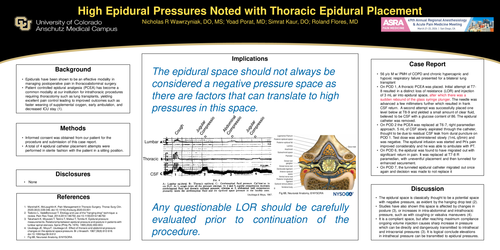
The epidural space is classically thought to be a potential space with negative pressure, as evident by the hanging drop test (2). Studies have also shown this space is affected by changes in posture (3), or increases in intra-abdominal and intrathoracic pressure, such as with coughing or valsalva maneuvers (4). It is a compliant space, but after reaching maximum compliance ongoing volume injection causes sharp increase in pressure which can be directly and dangerously transmitted to intrathecal and intracranial pressures (3). It is logical conclude elevations in intrathecal pressure can be transmitted to epidural pressures.
Implications
The epidural space should not always be considered a negative pressure space as there are factors that can translate to high pressures in this space. Any questionable LOR should be carefully evaluated prior to continuation of the procedure.
References
Marshall K, McLaughlin K. Pain Management in Thoracic Surgery. Thorac Surg Clin. 2020;30(3):339-346. doi:10.1016/j.thorsurg.2020.03.001
Todorov L, VadeBoncouer T. Etiology and use of the "hanging drop" technique: a review. Pain Res Treat. 2014;2014:146750. doi:10.1155/2014/146750
Takahashi K, Miyazaki T, Takino T, Matsui T, Tomita K. Epidural pressure measurements. Relationship between epidural pressure and posture in patients with lumbar spinal stenosis. Spine (Phila Pa 1976). 1995;20(6):650-653.
Usubiaga JE, Moya F, Usubiaga LE. Effect of thoracic and abdominal pressure changes on the epidural space pressure. Br J Anaesth. 1967;39(8):612-618. doi:10.1093/bja/39.8.612
Fig 6B, Neuraxial Anatomy, © NYSORA.