457 posters, 2 videos, 2 audios, 8 topics, 45 sessions, 401 authors, 265 institutions
ePostersLive by SciGen Technologies S.A. All rights reserved.
49th Annual Regional Anesthesiology and Acute Pain Medicine Meeting
March 21-23, 2024 | The Hilton Bayfront San Diego | San Diego, California

5401
IMPLEMENTING ITM FOR TOTAL JOINT ARTHROPLASTY ANALGESIA UNDER SPINAL ANESTHESIA: FROM JOURNAL CLUB TO OPERATING ROOM
Poster Presenter
Part of Topic
Safety/QA/QI Projects
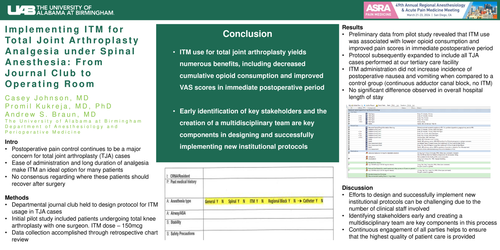
Implementing ITM for Total Joint Arthroplasty Analgesia under Spinal Anesthesia: From Journal Club to Operating Room
Casey Johnson, MD
Promil Kukreja, MD, PhD
Andrew S. Braun, MD
The University of Alabama at Birmingham
Department of Anesthesiology and Perioperative Medicine
Intro
•Postoperative pain control continues to be a major concern for total joint arthroplasty (TJA) cases
•Ease of administration and long duration of analgesia make ITM an ideal option for many patients
•No consensus regarding where these patients should recover after surgery
•
Methods
•Departmental journal club held to design protocol for ITM usage in TJA cases
•Initial pilot study included patients undergoing total knee arthroplasty with one surgeon. ITM dose – 150mcg
•Data collection accomplished through retrospective chart review
Results
•Preliminary data from pilot study revealed that ITM use was associated with lower opioid consumption and improved pain scores in immediate postoperative period
•Protocol subsequently expanded to include all TJA cases performed at our tertiary care facility
•ITM administration did not increase incidence of postoperative nausea and vomiting when compared to a control group (continuous adductor canal block, no ITM)
•No significant difference observed in overall hospital length of stay
Discussion
•Efforts to design and successfully implement new institutional protocols can be challenging due to the number of clinical staff involved
•Identifying stakeholders early and creating a multidisciplinary team are key components in this process
•Continuous engagement of all parties helps to ensure that the highest quality of patient care is provided