457 posters, 2 videos, 2 audios, 8 topics, 45 sessions, 401 authors, 265 institutions
ePostersLive by SciGen Technologies S.A. All rights reserved.
49th Annual Regional Anesthesiology and Acute Pain Medicine Meeting
March 21-23, 2024 | The Hilton Bayfront San Diego | San Diego, California

5116
IMPACT OF PERIOPERATIVE BLOCK NURSE IN A COMMUNITY-BASED ANESTHESIOLOGY PRACTICE
Poster Presenter
Authors
Affiliations
Part of Topic
Safety/QA/QI Projects
Impact of Perioperative Block Nurse in A Community-based Anesthesiology Practice
Tilman Chambers, MD1, Stephan Mouhanna, MD1, Cameron Howard, MD1,2,Walter Diaz, MD1,2, Gary Gomez, MD1,2, Julie Bowyer, RN1, Rebecca Andress, ARNP1,2, Dylan Irvine, DO3, Benjamin T. Houseman, MD, PhD1,2
1Memorial Hospital System, Pembroke Pines, FL, USA 2Envision Physician Services, Pembroke Pines, FL, USA 3Nova Southeastern University Dr. Kiran C. Patel College of Osteopathic Medicine, Davie, FL, USA
Background
Regional anesthesia has been shown to have many benefits in the perioperative period, but the development of a robust regional anesthesia program requires significant investment in both material and anesthesia personnel resources (1). The addition of a specialized “block” nurse to assist with regional anesthesia procedures has been shown to benefit the growth and operational efficiency of regional anesthesia programs in large academic practices (2), but the impact of a block nurse in high volume community-based anesthesia practices is less clear. This abstract describes the multi-year impact of a perioperative block nurse in a single hospital community-based regional anesthesia practice.
Materials and Methods
We analyzed billing records for anesthesia cases at our community hospital between 2018 and 2023 (n=97597) and identified records that billed for regional anesthesia. To account for changes in case mix that occurred throughout the year and in response to several COVID 19 pandemic waves, we calculated the percent of cases receiving a regional anesthetic and compiled data in three-month periods (quarters 1-4). A student t-test was performed to determine whether the percent of cases receiving a block in different quarters was statistically significant.
To assess the operational impact of the block nurse and other time saving measures, such as pre-assembled block kits and pre-mixed block syringes, we timed the block nurse and a CA1 resident preparing for a simulated transversus abdominal plane (TAP) block.
To assess the impact of the block nurse on our physician practice, faculty were asked to complete a brief four question survey using a 5-point Likert scale (1= strongly disagree, 5 = strongly agree).
Results/Case Report
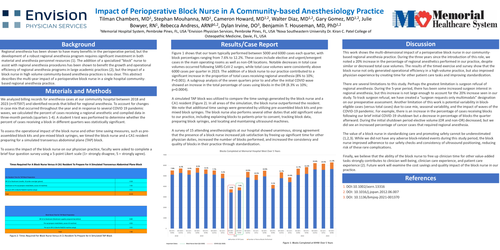
Figure 1 shows that our team typically performed between 5000 and 6000 cases each quarter, with block percentages ranging from 7.6% to 12.2%. These cases include elective and urgent/emergent cases in the main operating rooms as well as non-OR locations. Notable decreases in total case volumes occurred following SARS-CoV-2 surges, while total case volumes were consistently above 6000 cases per quarter in 2023. The addition of a block nurse to our practice contributed to a significant increase in the proportion of total cases receiving regional anesthesia (8% to 10%; P=0.001). A subgroup analysis of the seven quarters prior to and after the initial COVID wave showed an increase in the total percentage of cases using blocks in the OR (8.3% vs 10%; p=0.0004).
A simulated TAP block was utilized to compare the time savings generated by the block nurse and a CA1 resident (Figure 2). In all areas of the simulation, the block nurse outperformed the resident. We note that additional time savings were generated by utilizing pre-assembled block kits and pre-mixed block syringes. The block nurse also performs several other duties that add significant value to our practice, including explaining blocks to patients prior to consent, tracking block data, preparing block syringes, and locating and maintaining ultrasound machines.
A survey of 15 attending anesthesiologists at our hospital showed unanimous, strong agreement that the presence of a block nurse increased job satisfaction by freeing up significant time for other physician duties, increased the number of blocks performed, and increased the consistency and quality of blocks in their practice through standardization.
Results/Discussion
This work shows the multi-dimensional impact of a perioperative block nurse in our community-based regional anesthesia practice. During the three years since the introduction of this role, we noted a 20% increase in the percentage of regional anesthetics performed in our practice, despite similar or decreased total case volumes. The results of the timed exercise and survey show that the block nurse not only generated operational efficiency in a high-volume practice, but also improved physician experience by creating time for other patient care tasks and improving standardization.
There are several limitations to this study. Perhaps the greatest limitation is surgeon refusal of regional anesthesia. During the 5-year period, there has been some increased surgeon interest in regional anesthesia, but this increase is not large enough to account for the 20% increase seen in our study. To track surgeon refusal, we have created a “surgeon requests only multimodals” designation on our preoperative assessment. Another limitation of this work is potential variability in block-eligible cases (versus total cases) due to case mix, seasonal variability, and the impact of waves of the COVID-19 pandemic. For example, there is an increase in the percentage of cases receiving blocks following our brief initial COVID-19 shutdown but a decrease in percentage of blocks the quarter afterward. During the initial shutdown period elective volume (OR and non-OR) decreased, but we did see an increased percentage of cancer cases that required regional anesthesia.
The value of a block nurse in standardizing care and promoting safety cannot be underestimated (1,2,3). While we did not have any adverse block-related events during this study period, the block nurse improved adherence to our safety checks and consistency of ultrasound positioning, reducing risk of these rare complications.
Finally, we believe that the ability of the block nurse to free up clinician time for other value-added tasks strongly contributes to clinician well-being, clinician care experience, and patient care experience (2). Future work will examine the cost savings and quality impact of the block nurse in our practice.