457 posters, 2 videos, 2 audios, 8 topics, 45 sessions, 401 authors, 265 institutions
ePostersLive by SciGen Technologies S.A. All rights reserved.
49th Annual Regional Anesthesiology and Acute Pain Medicine Meeting
March 21-23, 2024 | The Hilton Bayfront San Diego | San Diego, California

5062
OPTIMIZING REGIONAL ANESTHESIA UTILIZATION IN HIP FRACTURE: STRATEGIES FOR IMPLEMENTATION
Poster Presenter
Authors
Affiliations
Part of Topic
Safety/QA/QI Projects
Optimizing Regional Anesthesia Utilization in Hip Fracture: Strategies for Implementation
Allen Yang, MD1, Jeffrey Kramer, MD MSc2, Gwen Baraniecki-Zwil2, Samir Mehta, MD3, Sheriza Hussain, MD4, Nabil Elkassabany, MD MSCE MBA5, Jason Ochroch, MD1
Dept of Anesthesiology and Critical Care1, Dept of Emergency Medicine2, Dept of Orthopaedic surgery3; University of Pennsylvania Health, Dept of Anesthesiology, MedStar Georgetown University Hospital4; Dept of Anesthesiology, University of Virginia5
Introduction
Over 300,000 adults are hospitalized annually in the United States due to hip fractures, with women experiencing a higher rate than men. In-hospital mortality, often caused by respiratory failure, is up to 3%. (1) Multiple societal guidelines recommend multimodal analgesia, including the use of peripheral nerve blocks. (2) Regional analgesia is effective and associated with multiple improved outcomes compared to opiates alone, yet it remains underutilized. (3) A recent retrospective cohort study found that only 4.6% of hip fracture patients received a peripheral nerve block for pain control. (4) There is limited literature on this discrepancy, with poorly defined interventions and varying degrees of sustained change. (5) We therefore implemented a program to increase utilization of peripheral nerve blocks for analgesia for acute geriatric hip fractures in an academic medical center, and to address the main barriers to offering regional analgesia for these patients.
Materials and Methods
The collaboration involved multiple specialties, including Anesthesiology, Emergency Medicine (EM), and Orthopedic Surgery. An ultrasound-guided infrainguinal fascia iliaca compartment block (FIB) program was established in a Level 1 trauma center. A literature search of published initiatives and an internal group survey identified three key barriers: protocol awareness, procedural comfort, and time/staffing constraints. These were targeted with low-effort, high-effect solutions.
Regional analgesia protocols for acute hip fractures were developed and extended to cover all geriatric hip fracture patients, irrespective of surgical intervention types. To improve communication, order set reminders in the electronic medical record system were updated to recommend an acute pain medicine consult. The block process was streamlined with the creation of pre-made supply kits.
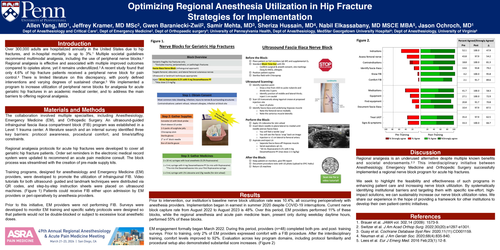
Training programs were developed to promote the utilization of infrainguinal FIB. Video tutorials for both ultrasound- guided and landmark techniques were distributed via QR codes, and step-by-step instruction sheets were placed on ultrasound machines. (Figure 1) These training programs were uniquely designed for anesthesiology and EM providers. In order to maximize uptake, patients could receive FIB either upon admission by EM providers or perioperatively by anesthesia providers.
Prior to this initiative, EM providers were not performing FIB. Surveys were developed to monitor EM training and specific safety protocols were designed so that patients would not be double-blocked or subject to excessive local anesthetic doses. Of note, the initiative began in 2020, but the implementation of training programs was delayed due to the outbreak of COVID-19 pandemic.
This report is devoid of patient identifiable information and is exempt from IRB review requirements as per University of Pennsylvania policy.
Results/Case Report
Prior to intervention, our institution’s baseline nerve block utilization rate was 10.4%, all occurring perioperatively with anesthesia providers. Implementation began in earnest in summer 2020 despite COVID-19 interruptions. Current nerve block capture rate from August 2022 to August 2023 is 48%. Over this period, EM providers performed 11% of these blocks, while the regional anesthesia and acute pain medicine team, present only during weekday daytime hours, performed 55% of these blocks.
EM engagement formally began March 2022. During this period, providers (n=48) completed both pre- and post- training surveys. Prior to training, only 2% of EM providers expressed comfort with a FIB procedure. After the interdisciplinary training, comfort levels improved to 92%. Evaluation across key program domains, including protocol familiarity and procedural setup also demonstrated substantial score increases. (Figure 2)
Discussion
Opiates, while common in hip fracture patients, pose risks. Regional analgesia is an underused alternative despite multiple known benefits and societal endorsements. (2-3) This interdisciplinary initiative between Anesthesiology, Emergency Medicine and Orthopedic Surgery successfully implemented a regional nerve block program for acute hip fractures.
We recognize that each institution has its own culture and pathways; with this work we seek to highlight the feasibility and effectiveness of such programs in enhancing patient care and increasing nerve block utilization. We have shown that by systematically identifying institutional barriers and targeting them with specific low-effort, high-impact solutions, we can sustainably increase our nerve block utilization rates. We share our experience in the hope of providing a framework for other institutions to develop their own patient-centric initiatives.
References
- Brauer et al. JAMA vol. 302,14 (2009): 1573-9.
- Switzer et al. J Am Acad Orthop Surg. 2022;30(20):e1297-e1301.
- Guay et al. Cochrane Database Syst Rev. 2020;11(11):CD001159.
- Neuman et al. J Am Geriatr Soc. 2020;68(4):835-840.
- Lees et al. Eur J Emerg Med. 2016 Feb;23(1):12-8.