457 posters, 2 videos, 2 audios, 8 topics, 45 sessions, 401 authors, 265 institutions
ePostersLive by SciGen Technologies S.A. All rights reserved.
49th Annual Regional Anesthesiology and Acute Pain Medicine Meeting
March 21-23, 2024 | The Hilton Bayfront San Diego | San Diego, California

5333
QUADRATUS LUMBORUM VERSUS TRANSVERSUS ABDOMINIS PLANE NERVE BLOCKS FOR PEDIATRIC RENAL TRANSPLANTATION: A RETROSPECTIVE STUDY
Poster Presenter
Part of Topic
Safety/QA/QI Projects
Title: Quadratus Lumborum Versus Transversus Abdominis Plane Nerve Blocks for Pediatric Renal Transplantation: A Retrospective Study
Introduction:
- Effective pain management following pediatric renal transplantation is challenging.
- There is a paucity of evidence for the use of peripheral regional anesthesia.
- QL and TAP blocks have been used for adult renal transplantation analgesia.
- This retrospective study evaluated the effectiveness of QL blocks and TAP blocks in pediatric renal transplantation.
- Primary outcome: Postoperative opioid consumption measured in morphine milligram equivalents (MME)
- Secondary outcome: Time to extubation
- We hypothesize that QL blocks will be more effective in reducing postoperative opioid consumption in the first 24 hours following pediatric renal transplantation.
Methods:
- Following IRB exemption, a retrospective chart review was conducted on all patients under 21 years of age undergoing renal transplantation at a single academic pediatric hospital from 2019 to 2023.
- Exclusion criteria included weight less than 15 kg and chronic pain.
- A total of 108 patients undergoing kidney transplant surgery were divided into one of four categories:
- Unilateral QL block with contralateral rectus sheath (RS) block [QL group]
- “High-dose” unilateral TAP block where the weight-based local anesthetic administered exceeded 40% of the patient’s maximum allowable local anesthetic mass in milligrams [hTAP group]
- “Low-dose” unilateral TAP [lTAP group]
- No block group
- All blocks were single injections without the use of any adjuvants.
Results:
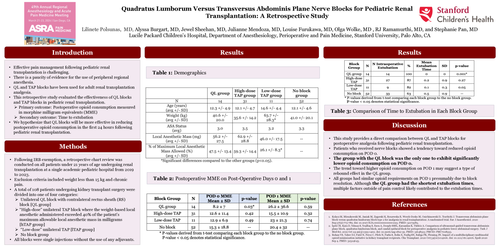
Demographics for the 4 groups (Table 1) were similar except for a greater average weight in the lTAP group. The QL group had significantly reduced opioid consumption on POD 0 as compared to the no block group (p=0.03), but not on POD 1 (Table 2). Comparisons between all other groups did not yield any differences in opioid consumption for either POD 0 or POD 1. All patients in the QL group were extubated in the operating room, hence demonstrating the shortest extubation times (p=0.001) (Table 3).
Discussion:
- This study provides a direct comparison between QL and TAP blocks for postoperative analgesia following pediatric renal transplantation.
- Patients who received nerve blocks showed a tendency toward reduced opioid consumption on POD 0.
- The group with the QL block was the only one to exhibit significantly lower opioid consumption on POD 0.
- The trend toward higher opioid consumption on POD 1 may suggest a type of rebound effect in the QL group.
- All groups had similar opioid requirements on POD 1 presumably due to block resolution. Although the QL group had the shortest extubation times, multiple factors outside of pain control likely contributed to the extubation times.